
Blog - CTOA

Bring to the table win-win survival strategies to ensure proactive domination. At the end of the day, going forward, a new normal that has evolved from generation.
Panel-discussion-1-1280x686.jpg

April 28, 2026

Event highlights trucking’s central role in Canada’s economy and reinforces the need for practical, real-world solutions across the industry

DOLLARD-DES-ORMEAUX, QC: – The Canada Truck Operators Association (CTOA) brought together more than 600 transportation and logistics professionals, policymakers, and industry leaders at a sold-out National Industry Appreciation & Information Session, marking one of the largest recent gatherings of Canada’s trucking sector.

The event convened stakeholders from Québec and Ontario for focused discussions on supply chain resilience, operational realities, safety, and the evolving needs of Canada’s transportation industry.

Trucking at the Center of Canada’s Economy

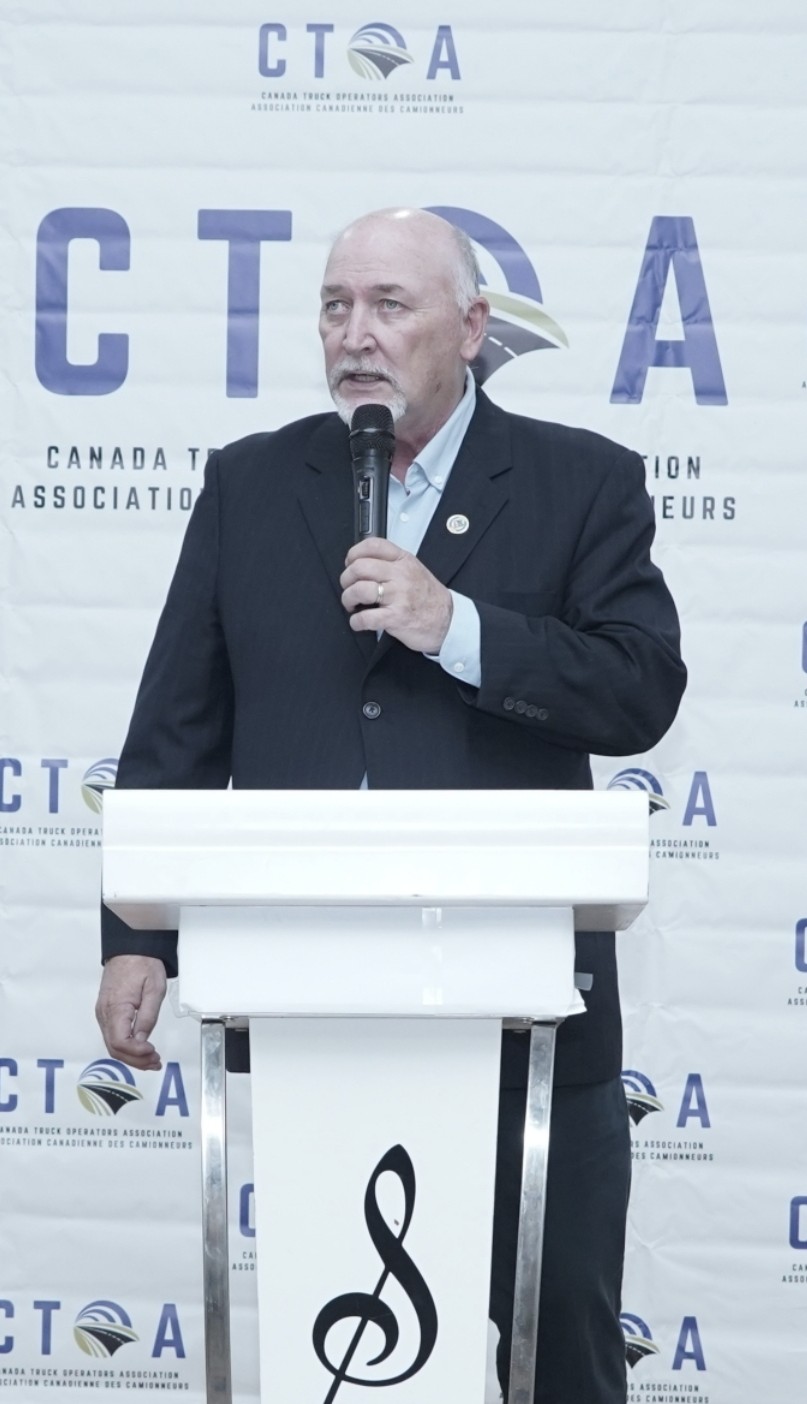
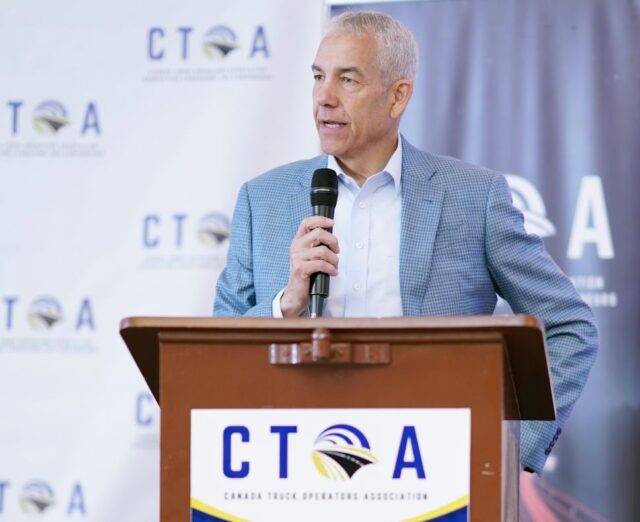
 Frank Baylis, Canadian business leader and former Member of Parliament, emphasized the foundational role of trucking in the national economy.

Keynote speaker Frank Baylis, Canadian business leader and former Member of Parliament, emphasized the foundational role of trucking in the national economy.

“Trucking is not just a sector, it is the backbone of Canada’s economy,” said Baylis, highlighting the importance of long-term infrastructure investment and strategic planning to support national growth and competitiveness.


Government Leaders Emphasize Collaboration and Industry Engagement


Federal and provincial leaders underscored the importance of collaboration between government and industry stakeholders.

The Honourable Marc Miller, Minister of Canadian Identity and CultureThe Honourable Marc Miller, Minister of Canadian Identity and Culture, acknowledged the importance of a coordinated industry voice:

“A strong and organized industry voice is essential in ensuring that key challenges and opportunities are addressed.”


Peter Schiefke, MP, Chair of the House of Commons Standing Committee on Transport, reinforced the sector’s national significance:

“When trucking moves, Canada moves… This gathering reflects the strength of the transportation and logistics sector and its critical role in keeping our economy moving.”

Peter Schiefke, MP, Chair of the House of Commons Standing Committee on Transport, reinforced the sector’s national significance:Additional officials in attendance included MP Sameer Zuberi, MNA Brigitte B. Garceau, and Mayor Alex Bottausci, reflecting engagement across all levels of government.


From Challenges to Practical Solutions

The symposium featured two solution-focused panels addressing:

  • Managing Risk, Costs & Growth in Trucking: Insurance, Financing, AI & data-driven insights
  • Building a Safer Trucking Industry – Maintenance, Responsibility & Practical Solutions
Panel discussion Building a Safer Trucking Industry in Canada - Maintenance, Responsibility & Practical Solutions
Building a Safer Trucking Industry – Maintenance, Responsibility & Practical Solutions

Discussions focused on practical, real-world solutions, including:

  • The growing role of technology and data in managing risk and improving efficiency
  • The importance of preventive maintenance and strong operational discipline
  • Addressing driver well-being and ongoing workforce pressures
  • Strengthening long-term stability through better industry practices

A Ground-Level Perspective on Industry Representation

In opening remarks, CTOA emphasized the importance of ensuring that policy conversations reflect the realities on the ground.

“When trucking moves, Canada moves, yet the voices of the people operating on the ground have not always been fully heard at the national level,” CTOA leadership noted.

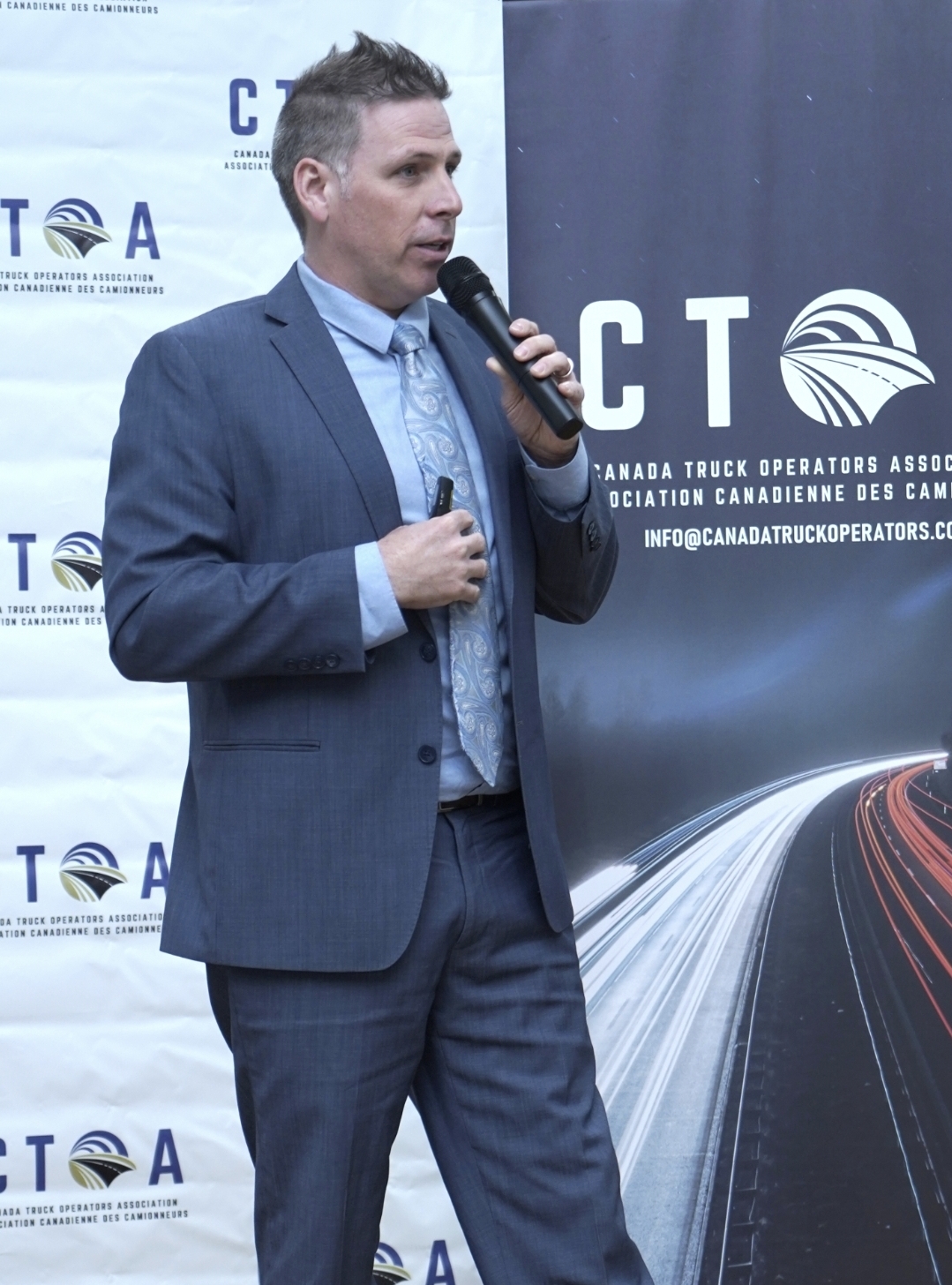
Tejpreet (Tej) Dulat“This industry is evolving, and our approach must evolve with it,” said Tej Dulat, representing CTOA leadership.  “Businesses want clarity, workers want opportunity, and everyone wants to operate within a system that is fair, practical, and consistent. CTOA’s role is to help bring those realities into the conversation in a constructive and responsible way.”

Adapting to a Changing Industry

The event also highlighted broader changes shaping the transportation sector, including:

  • Shifting workforce expectations
  • Increased use of digital tools and technology
  • The need for approaches that reflect how today’s operators and businesses function

Participants emphasized that long-term workforce sustainability will depend on the industry’s ability to adapt while maintaining strong standards around safety and compliance.

A Sector That Powers Canada

With nearly 70% of goods in Canada transported by truck, the sector remains a critical pillar of the national economy and supply chain.

Participants reinforced the importance of:

  • Continued infrastructure investment
  • Aligning policy with operational realities
  • Maintaining strong safety and compliance standards
  • Supporting a diverse and evolving workforce

Looking Ahead

CTOA will continue to engage with policymakers and stakeholders across Canada to support a stable, competitive, and forward-looking transportation sector, with a focus on practical solutions, industry collaboration, and long-term sustainability.

Media Contact

Canada Truck Operators Association (CTOA)
info@thectoa.ca
www.thectoa.ca


Header-About-Us-e1776185677656.jpg

April 14, 2026

CTOA noted that a coordinated approach across federal and provincial governments could further enhance the effectiveness of recent measures.

MISSISSAUGA, ON / April 14/ : The Canadian Truck Operators Association (CTOA) welcomes the federal government’s announcement to temporarily suspend the federal fuel excise tax on diesel and gasoline, calling the measure a constructive and timely step that will provide short-term relief to trucking operators facing renewed fuel cost pressures.

The federal government has indicated that the temporary measure will take effect on April 20 and remain in place until September 7, 2026. The suspension is expected to reduce diesel prices by approximately 4 cents per litre and is intended to help lower operating costs for truckers and businesses across key sectors of the economy.

CTOA raised concerns on March 30 regarding rising diesel prices, exceeding $2.39 per litre in parts of the Greater Toronto Area, and the impact on small carriers and independent operators still recovering from a prolonged freight slowdown between 2022 and 2025.

“We are encouraged to see this announcement align with concerns raised by trucking operators and industry stakeholders in recent weeks,” said Tej Dulat, spokesperson for CTOA. “CTOA has been actively highlighting the impact of rising fuel costs on small carriers, and this decision represents a constructive step toward addressing those pressures.”

“For many small carriers and owner-operators, every cent matters. This measure will provide meaningful short-term relief and signals that government recognizes the challenges facing an essential industry that keeps Canada’s economy and supply chains moving.”

Relief Comes Amid Fragile Recovery

While the measure is expected to provide immediate cost relief, CTOA emphasizes that many operators remain in a fragile recovery phase following several years of, Weak freight rates, Excess capacity, Rising insurance and maintenance costs

For smaller operators in particular, limited financial reserves and ongoing cost pressures continue to impact day-to-day operations.

“This is a positive and responsible step,” Dulat added. At the same time, many smaller operators are still stabilizing after several difficult years. We see this as an important first measure, and we look forward to continued engagement with government on practical ways to support sector stability.”

Ensuring Effective Impact

CTOA also noted that the effectiveness of the measure will depend on how efficiently fuel cost reductions are reflected across the supply chain.

To maximize the impact of this decision, it will be important that fuel cost reductions are clearly reflected at the pump so that operators and consumers can fully benefit, Dulat said.

Coordinated Approach Across Jurisdictions

CTOA noted that a coordinated approach across federal and provincial governments could further enhance the effectiveness of recent measures.

“We welcome the federal government’s leadership on this issue,” Dulat said. There may be an opportunity for provinces to consider similar short-term measures within their jurisdictions to further support small carriers and ensure more consistent relief across the country.”

Continued Focus on Industry Stability

CTOA is encouraging continued dialogue on additional targeted measures that can support small carriers and owner-operators, including:

  • Review and modernization of fuel surcharge mechanisms
  • Improved access to short-term working capital
  • Industry-government roundtable on trucking sector stability

“This is not about long-term subsidies,” Dulat said. It is about ensuring that small operators have the ability to remain stable and competitive during periods of cost volatility.”

Broader Economic Importance

Canada’s trucking sector plays a central role in the movement of goods across the country. Cost pressures in transportation can have broader impacts on supply chains, business costs, and affordability for consumers. CTOA will continue to monitor developments and engage constructively with policymakers and industry stakeholders to support a stable, resilient, and competitive trucking sector.

Media Contact

Canadian Truck Operators Association (CTOA)
📧 info@thectoa.ca
🌐 www.thectoa.ca


Diesel.jpg

March 30, 2026

CTOA warns rising diesel prices, now exceeding $2.39 per litre in Toronto, are adding pressure to small carriers and independent operators already recovering from a prolonged industry downturn

MISSISSAUGA, ONMarch 30, 2026: The Canadian Truck Operators Association (CTOA) is raising concerns over rising diesel prices, warning that increasing fuel costs are placing renewed pressure on a trucking industry that is still in the early stages of recovery following a prolonged slowdown from 2022 through 2025.

Recent increases in global oil prices, driven by escalating geopolitical tensions in the Middle East affecting key energy supply routes, are beginning to translate into higher diesel costs across Canada. For the trucking sector, where fuel remains one of the largest operating expenses, this trend is creating immediate financial strain, particularly for small and mid-sized carriers.

Diesel prices in major markets such as the Greater Toronto Area have recently exceeded $2.39 per litre, levels not seen since 2022. For many operators, this represents a significant increase in day-to-day operating costs.

While larger carriers may have mechanisms to manage fuel volatility, smaller fleets and independent operators often have limited ability to pass on sudden cost increases, creating immediate pressure on margins and cash flow.

“Canada’s trucking industry has gone through several difficult years, and many carriers are only now beginning to stabilize,” said Tej Dulat, spokesperson for CTOA. “A sudden increase in fuel costs at this stage creates real pressure for businesses that are already operating on thin margins. This is not about avoiding normal market cycles, it is about recognizing the impact of external cost shocks on an essential industry.”

A Fragile Recovery at Risk

The current increase in diesel prices comes at a sensitive time for the industry.

Between 2022 and 2025, Canadian trucking experienced a prolonged period of weak freight rates, excess capacity, and rising operational costs. Many small carriers and owner-operators managed this period by reducing expenses, deferring investments, and operating with minimal financial reserves.

While early signs of stabilization have begun to emerge in 2026, the recovery remains uneven. Rising fuel costs now risk slowing that recovery, particularly for operators with limited ability to absorb additional cost increases.

The View from the Ground

“I run four trucks out of the GTA. Fuel has gone from about $1,600 to $2,300 per truck, that’s a $700 increase every fill. I am transporting essential goods and can’t stop operating, but after three difficult years, there is very little left to absorb these costs. My line of credit is already stretched.”
Jagroop, CTOA member, Greater Toronto Area

“I have been operating for 14 years, and have never seen two pressures hit at the same time like this. After years of low freight rates, diesel is now above $2.40 with no clear timeline for relief. This goes beyond normal market conditions,  it is a situation operators cannot plan for or control.
Singh, CTOA member, Hamilton

Broader Supply Chain Impact

The impact of rising diesel prices extends beyond the trucking industry. Trucking plays a central role in Canada’s economy, with the majority of goods transported by truck at some stage of the supply chain. As transportation costs increase, those costs can flow through to businesses and consumers in the form of higher prices for goods and services.

Fuel volatility therefore has implications not only for carriers, but for overall supply chain stability and affordability.

CTOA Encourages Consideration of Targeted Measures

CTOA is encouraging the Government of Canada and the Government of Ontario to consider practical, short-term measures to support industry stability during periods of fuel volatility:

  • Temporary diesel tax relief for commercial carriers
  • Targeted bridge financing access for small carriers and owner-operators
  • Review and update of fuel surcharge mechanisms
  • Industry-government roundtable on trucking sector stability
  • Short-term flexibility in compliance implementation for small carriers

CTOA emphasizes that the industry is not seeking long-term subsidies, but targeted, short-term support to help stabilize an essential sector during a period of exceptional cost volatility.

Looking Ahead

CTOA will continue to monitor developments and engage with industry stakeholders to assess the impact of rising fuel costs across regions and business segments.

The association remains focused on supporting a stable, resilient trucking sector that can continue to meet the needs of Canada’s economy and supply chains.


truck-3.jpg

March 23, 2026

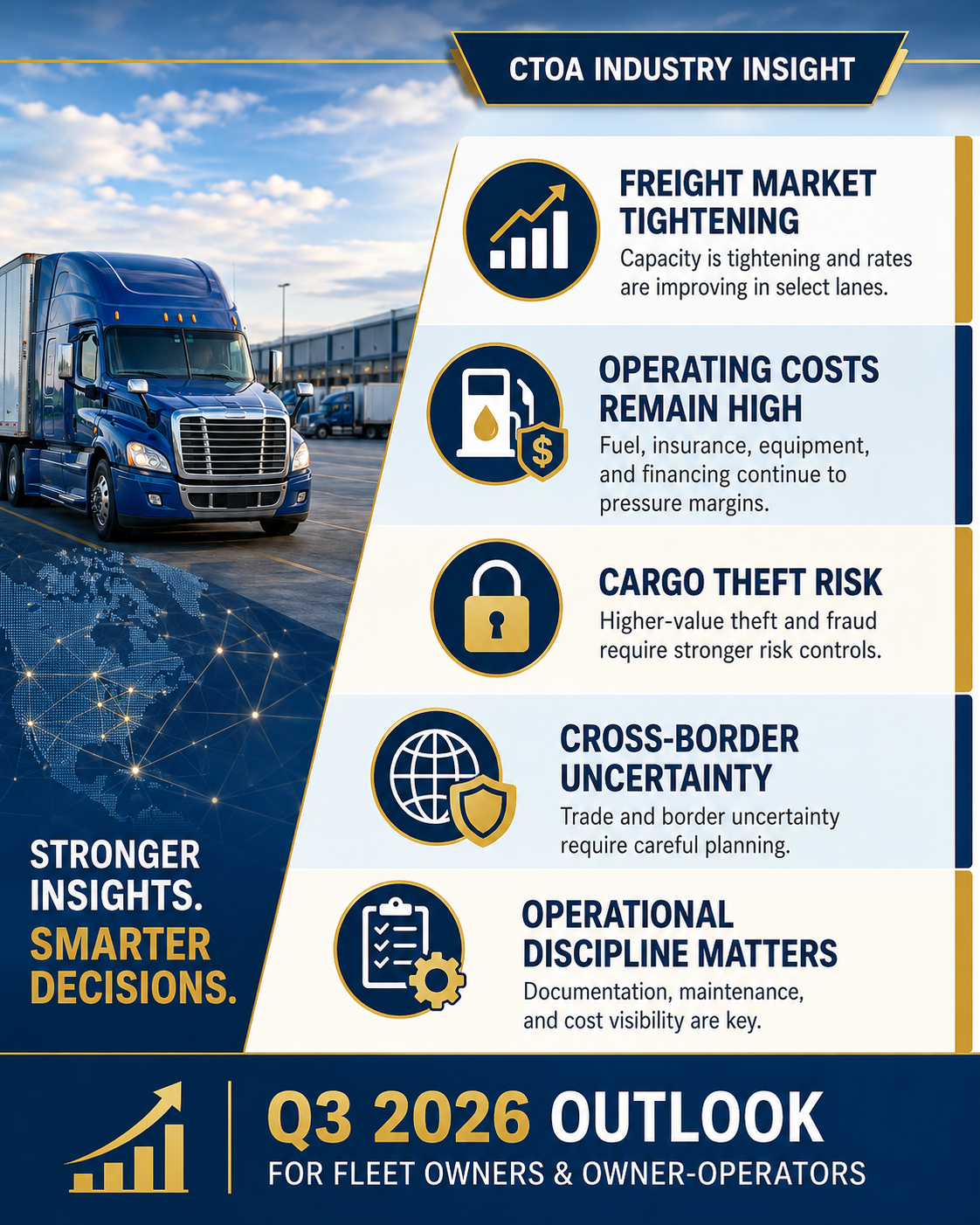
Market Analysis & Strategic Outlook (2026–2027)

After two years of oversupply and compressed margins, Q1 2026 shows early evidence of a tighter, more disciplined carrier base. The next 18 months will reward carriers who manage capital carefully, adapt to regulatory change, and monitor a set of converging trade, infrastructure, and workforce pressures that are reshaping the industry’s operating environment.


Section I: Current Market Conditions


The excess capacity that weighed on Canadian freight markets through 2024 and into 2025 is beginning to clear. This is not a demand-driven recovery, it reflects the exit of smaller, undercapitalized carriers who were unable to absorb sustained cost increases across insurance, fuel, financing, and maintenance.

The result is a leaner industry than existed two years ago. The remaining carrier base is, on balance, better capitalized and more operationally disciplined. That shift is beginning to reflect in spot rates, which have stabilized and shown early signs of a modest recovery in several key corridors.

4-6%
SPOT RATE RECOVERY

Year-over-year rate improvement in key Canadian corridors as of Q1 2026, per industry analyst consensus. Recovery remains uneven across sectors and regions.

10-15%
CAPACITY SHORTFALL

Driver vacancy rate reported by a segment of CTOA member carriers in early 2026, adding a structural supply constraint alongside equipment-side contraction.

 
The persistent challenge is what analysts call a cost-revenue squeeze: Operating expenses, particularly insurance premiums and maintenance labour, continue to rise faster than freight rates. Carriers that have survived this cycle are those who controlled variable costs aggressively. That discipline will remain a competitive differentiator through 2027.
 
Market Signals – Q1 2026
  • Operating authority cancellations have accelerated as smaller fleets exit under sustained margin pressure.
  • Spot rates stabilizing, modest early recovery in Toronto-Montreal and Toronto-Calgary corridors.
  • Used equipment demand rising as new truck pre-purchases begin to build ahead of 2027 regulatory changes.
  • Insurance premiums remain elevated, cargo theft is contributing materially to claims costs in the GTA/Peel corridor.
  • 11000 plus transport driver positions were vacant in Canada as of Statistics Canada Q3 2025 – a structural, not cyclical, shortage.

Section II – Two Developments to Watch in 2026


Two distinct developments will materially affect Canadian freight flows this year. Both carry meaningful uncertainty and warrant closer attention from carriers than they have received so far.


The Gordie Howe International Bridge

Canada’s most significant trade infrastructure investment in decades is approaching its opening. Construction of the Windsor-Detroit crossing is complete. As of March 2026, the bridge is in its testing and commissioning phase, with toll rates officially announced on March 11. Commercial vehicle tolls are set at US$8.75 / CA$12 per axle, materially lower than the Ambassador Bridge’s current rate of US$20 per axle. The U.S. Department of Homeland Security formally designated the crossing as a Class A port of entry effective March 2, 2026.

No firm opening date has been confirmed as of the publication of this report. The Windsor-Detroit Bridge Authority has indicated a spring 2026 target, contingent on completion of quality reviews and readiness of border agencies on both sides.

Political Risk – Monitor Closely

In February 2026, U.S. President Donald Trump raised concerns regarding the bridge’s toll structure and construction materials. Canadian officials, including Prime Minister Carney, addressed these claims directly. The threat has not been formally withdrawn. Members with significant Windsor-Detroit exposure should monitor this situation before building the new crossing into routing and scheduling plans. CTOA will issue an advisory when an opening date is confirmed.

If and when the bridge opens on the currently projected timeline, carriers can reasonably expect: reduced congestion at the Ambassador Bridge, more predictable border processing times, a competitive toll environment, and a direct Highway 401 to Interstate 75 connection that eliminates the current city-street routing on the Canadian side.

“About US$250 billion in goods cross the Detroit-Windsor corridor annually. CBP projects the new bridge will reduce average crossing times by up to 30 percent once fully operational.”  “U.S. Customs and Border Protection, Federal Register, January 2026″


The CUSMA/USMCA Joint Review – July 1, 2026

The mandatory six-year review of the Canada-United States-Mexico Agreement begins July 1, 2026. This is a structured joint review, not a formal renegotiation. The agreement does not expire or automatically change on that date; if parties do not agree to extend it, the process shifts to annual reviews. The agreement remains in force throughout.

That said, the current U.S. administration has signalled it intends to use this review to seek material changes, and the broader trade environment, including the 25% tariffs imposed on Canada in early 2025 and subsequent partial relief, underscores that cross-border freight operators are navigating genuine policy volatility. The tariff situation has shifted multiple times in 2025 and 2026; members with cross-border exposure should verify their specific commodity’s current tariff status with a customs broker rather than relying on any fixed figures.

July 1

CUSMA Review Begins
Mandatory six-year joint review. Agreement remains in force. Outcome uncertain under current U.S. administration.

Rules of Origin

Key Compliance Area
Auto parts and steel classifications will face the most scrutiny. Review your commodity compliance before July.

~$250B+

Annual Corridor Value

The Windsor–Detroit corridor is a critical trade gateway, within over $1.3 trillion in annual Canada–U.S. trade.

Cross-border fleets should use the period between now and July to review rules of origin compliance, particularly for automotive components and steel products, and to strengthen customs documentation practices. This is preparation, not alarm.

Section III – The 2027 Emissions Transition


The most significant equipment cost event in years is approaching. The U.S. EPA’s 2027 greenhouse gas and low-NOx standards for heavy-duty vehicles will drive a step change in new truck pricing. Because North American original equipment manufacturers produce to a single continental standard, Canadian carriers purchasing Class 8 trucks will face the same cost increase as their U.S. counterparts.
Current industry estimates, from CDK Global and truck manufacturer guidance,  project new 2027-compliant trucks at approximately $20,000–$25,000 more per unit than equivalent 2026 models, primarily due to more complex aftertreatment systems. These systems also carry meaningful maintenance implications during their early years in service.
 

What Members Need to Know – 2027 Emissions Rule

  1. The rule is a U.S. EPA rule: Canada’s Heavy-Duty Vehicle GHG Regulations run in parallel but on a separate schedule, verify with your dealer what applies to your fleet
  2. The EPA signaled in early 2026 that a revised proposal is expected in spring 2026, which could reduce per-unit cost impact while maintaining the 2027 start date
  3. Members should avoid locking in large pre-buy orders until the revised rule is finalized (expected Q2/Q3 2026), as cost structures may change
  4. The pre-buy cycle (rush to purchase 2026-spec trucks before Q4) is real, but early movers risk buying ahead of potential regulatory adjustments
  5. Used equipment values are expected to rise as demand for 2026-spec diesel trucks increases, relevant for fleets considering disposals this year

The practical planning recommendation is clear: evaluate your fleet replacement schedule now, but avoid reactive purchasing before the revised EPA rule is published. The window for informed decision-making is approximately Q2 2026.

Section IV – Regulatory & Workforce Pressures


Tax Compliance – T4A Enforcement Is Live

The CRA’s moratorium on T4A penalties for independent contractors in the trucking sector has ended. The reporting deadline for the 2025 tax year, T4A Box 048 for fees paid to Canadian Controlled Private Corporations over $500, passed on Feb 28th, 2026 (March 2, 2026). Enforcement is active. This is not a future concern, it is the current operating reality.

CTOA’s position has been consistent: comply with reporting requirements, and expect CTOA to ensure enforcement is applied fairly & consistently. If you received a compliance notice and have not yet responded, contact info@thectoa.ca immediately.

Workforce – A Structural Shortage, Not a Cyclical One

Statistics Canada reported 11000 plus vacant transport truck driver positions in Q3 2025. Multiple CTOA member carriers report current vacancy rates of 10% to 15%. This is not a short-term matching problem, it reflects an aging driver demographic, insufficient domestic training pipeline, and in CTOA’s assessment, retention barriers including discriminatory treatment and online hostility toward racialized and newcomer drivers that is driving experienced workers out of the industry.

Immigration pathways remain a material component of driver supply. Members relying on workers through temporary permit programs should verify current Express Entry draw categories for transport occupations directly with an immigration lawyer or through IRCC, as program criteria and draw schedules evolve regularly. CTOA will share updates as IRCC confirms 2026 draw schedules.

Cargo Theft – A Growing Operational and Financial Risk

North American cargo theft losses reached an estimated $725 million in 2025, with hundreds of documented incidents in Canada and the United States in Q3 2025 alone. Criminal networks have adopted more sophisticated methods, including fictitious carrier identities and fraudulent load authorizations. The GTA and Peel Region represent a disproportionate concentration of incidents.

CTOA launched a national freight security initiative in March 2026 to address this through real-time information sharing, and coordinated engagement with law enforcement. The initiative is operational and member participation is open. Contact info@thectoa.ca for details.

Section V – Strategic Priorities for 2026


The following recommendations reflect current market and regulatory conditions. They are intended as a framework for decision-making, not a prescriptive plan.


01

Evaluate Fleet Replacement Timelines –

But Wait on Large Orders

Know your replacement schedule. Do not commit to large pre-buy orders before the EPA publishes its revised 2027 rule in Q2/Q3 2026. Monitor the market carefully through summer.

02

Prepare for the Windsor-Detroit Corridor Shift

Once the Gordie Howe Bridge opens, toll competition and routing changes will affect lane economics. Build familiarity with the new crossing now.

03

Review Cross-Border Compliance Before July 1

Audit rules of origin documentation. Engage a customs broker if needed. Do not wait for the CUSMA review to trigger action.

04

Strengthen Cargo Security Protocols

Implement two-step verification for load releases. Join CTOA’s freight security initiative to reduce risk and insurance exposure.

05

Protect Margins Through Cost Discipline

Focus on insurance, fuel efficiency, and maintenance optimization. Benchmark against peers in your operating corridor.

06

Engage With CTOA’s Policy Work

Policy changes around independent driver classification and enforcement are underway. Member participation ensures your voice is represented.

CTOA Outlook :- 2026–2027

The conditions ahead do not reward the fastest or the largest. They reward carriers who manage their balance sheets carefully, anticipate regulatory change before it becomes a crisis, and operate with the discipline that the last two years of margin pressure have, of necessity, installed.

The carriers who exit 2027 in a stronger position than they entered 2026 will be those who used this transition period to prepare, not those who moved reactively once the environment shifted.

CTOA will continue to monitor and report on each of these files as they develop. The Gordie Howe Bridge opening, the EPA revised rule, and the CUSMA review are all active situations. Members should expect direct updates from CTOA as material developments occur.

Editorial note: This report synthesizes publicly available market data, regulatory filings, and CTOA’s direct advocacy experience. Where forward projections are cited, they represent the current consensus of industry analysts and may evolve as new information emerges, including the U.S. EPA’s forthcoming revised emissions rule expected in Q2/Q3 2026. Members should verify time-sensitive regulatory and tariff details directly with their advisors before making capital commitments.


March 17, 2026

This is not just a trucking issue, it is a national supply chain and economic security issue that requires coordinated action

Mississauga, ON (March 17) :  The Canadian Truck Operators Association (CTOA) is planning to launch a national freight security initiative aimed at addressing the growing problem of cargo, trailer, and equipment theft across Canada.

Cargo theft has become an increasingly serious threat to trucking companies, freight brokers, shippers, insurers, and the broader Canadian supply chain. According to industry estimates and cargo security reports, cargo theft across North America has escalated significantly, with losses reaching approximately $725 million in 2025, representing a sharp increase from previous years.

With over 70% of Canada’s domestic freight moved by trucks, rising cargo theft is not just an industry concern, it is a growing supply chain security issue that can impact businesses, consumers, and economic stability across the country.

Canadian law enforcement and industry stakeholders have also reported increasing theft activity in key logistics regions, particularly in major freight corridors such as the Greater Toronto Area and Peel Region, where hundreds of incidents have been recorded in recent years.

Organized criminal networks are increasingly targeting high-value shipments using sophisticated tactics such as fraudulent carrier identities, fictitious pickups, and coordinated cargo theft operations. These developments reflect a growing concern that cargo theft is evolving into a more organized and systemic challenge affecting the transportation sector.

In response, CTOA has begun facilitating information sharing among its members regarding theft incidents, suspicious activities, and emerging patterns, helping carriers and drivers respond more quickly to potential threats.

Building on these efforts, CTOA is engaging with industry stakeholders, law enforcement agencies, insurers, technology providers, and government bodies as it prepares to develop a national information-sharing and coordination framework aimed at preventing cargo theft and improving recovery of stolen freight and equipment.

“Freight and trailer theft is no longer an isolated issue affecting a few companies, it is becoming a broader supply chain security challenge,” said Tej Dulat, CTOA. “CTOA has started working with our members to share information and raise awareness, and we are preparing to help lead a coordinated effort with industry partners, law enforcement, and policymakers to address this problem.”

“This is not just a trucking issue, it is a national supply chain and economic security issue that requires coordinated action,” Dulat added.

As part of the proposed initiative, CTOA is exploring several practical measures:

  • Improving real-time information sharing between trucking companies, brokers, insurers, and law enforcement
  • Developing an industry alert system to notify fleets and professional drivers of stolen freight, suspicious pickups, and emerging threats
  • Strengthening collaboration with federal, provincial, and municipal authorities on cargo theft investigations and enforcement
  • Promoting security awareness and prevention training for fleets, drivers, dispatchers, brokers, and warehouse personnel
  • Encouraging more consistent reporting and improved data collection related to cargo theft incidents

CTOA believes that stronger coordination between industry participants and public authorities can significantly improve both prevention and recovery efforts.

“Canada’s economy depends on a secure and reliable trucking network,” Dulat said. “By working together and sharing information more effectively, the industry and government can take meaningful steps to protect freight, strengthen supply chains, and reduce the impact of organized cargo theft.”

CTOA is committed to playing a leadership role in bringing together industry and public stakeholders to address this growing challenge and will be engaging partners in the coming weeks as it advances this initiative.

Media contact: To request comment or information from CTOA, Please email info@thectoa.ca


portfolio_01-1280x853.jpg

March 11, 2026

CTOA Industry Insight / Topic: Insurance, Safety, Policy

The Canadian Truck Operators Association (CTOA) represents trucking operators, fleet owners, brokers, and industry stakeholders across Canada. As discussions continue around rising insurance premiums in the trucking sector, it is important to examine the broader factors influencing transportation risks and insurance costs.

Recent industry conversations have highlighted accident severity and claims costs as key contributors to rising premiums. While these factors certainly play a role, the issue is far more complex and reflects significant economic, infrastructure, and transportation changes that have taken place over the past decade.

A balanced and comprehensive understanding of these factors is essential to developing policies that support both road safety and a resilient national supply chain.

Growth in Traffic and Road Congestion

Canada has experienced significant population growth and economic expansion over the past decade. As cities expand and economic activity increases, the number of vehicles on the road has also grown considerably.

Passenger vehicles, delivery vans, ride‑share vehicles, and commercial trucks have all increased. However, in many regions, road infrastructure has not expanded at the same pace.

Major freight corridors such as the Greater Toronto Area, Montreal, Vancouver, and Calgary are experiencing increasing congestion. Higher traffic density naturally increases the likelihood of road incidents for all road users, not just commercial trucks.

Understanding these broader transportation trends is important when evaluating safety risks and insurance claims across the sector.

Expanding Freight Demand and Supply Chain Growth

Over the past decade, Canada’s supply chain has undergone significant transformation. The rapid growth of e‑commerce, national distribution networks, and just‑in‑time delivery systems has increased demand for freight transportation.

Retailers, manufacturers, and logistics companies rely heavily on trucking to move goods efficiently across the country. As freight demand increases, trucks spend more time on the road and operate across increasingly complex logistics networks.

Trucking remains the backbone of Canada’s supply chain, ensuring that businesses and consumers receive essential goods every day.

Rising Equipment and Repair Costs

Another major factor influencing insurance claims is the rising cost of modern trucking equipment and repairs.

Today’s commercial trucks are significantly more advanced than they were a decade ago. They include complex electronics, safety sensors, and advanced driver‑assistance technologies. While these innovations improve safety and operational efficiency, they also increase the cost of repairs.

In addition, higher labour costs for technicians, global supply chain disruptions, and more expensive replacement parts have contributed to rising repair expenses.

As a result, even relatively minor collisions can generate significantly higher claim values than in the past.

Economic Pressures Across the Transportation Sector

The trucking industry has also experienced broader economic pressures in recent years. Rising fuel prices, higher financing costs for vehicles, inflation in parts and maintenance, and increased labour costs have all affected operating expenses.

These broader economic conditions influence the cost of claims and the financial models used within the insurance sector.

Understanding these pressures helps provide a more complete picture of the challenges faced by both trucking operators and insurers.

Road Safety Is a Shared Responsibility

Road safety is influenced by many factors across the entire transportation ecosystem. Traffic congestion, infrastructure design, driver behaviour across all vehicle types, weather conditions, and road conditions can all contribute to collisions.

For this reason, improving road safety requires a system‑wide approach that involves government, transportation planners, insurers, and industry stakeholders.

Focusing on the broader transportation environment helps ensure that policies address the root causes of safety risks rather than attributing responsibility to a single segment of the industry.

Technology and Safety Improvements

The trucking industry has made significant investments in technology to improve safety and reduce operational risks.

Many fleets are adopting tools such as:

  • telematics systems
  • dash cameras
  • driver monitoring technologies
  • advanced safety management programs

These technologies help companies better understand driving behaviour, identify safety risks early, and strengthen training programs for drivers. Over time, these investments can contribute to safer operations and improved risk management across the industry.

The Importance of Collaboration

Rising insurance costs affect the entire supply chain, including trucking companies, insurers, retailers, manufacturers, and consumers.

The Canadian Truck Operators Association (CTOA) believes that addressing these challenges requires constructive collaboration between government, insurers, and industry stakeholders.

Policy discussions should focus on:

  • improving transportation infrastructure
  • strengthening safety programs and driver training
  • addressing insurance fraud and cargo theft
  • supporting the adoption of safety technologies
  • ensuring transparency and stability in insurance markets

A collaborative approach will help ensure that policies support both road safety and a stable, efficient supply chain.

Key Industry Trends Influencing Insurance Costs

Several long‑term transportation trends help explain the changing insurance environment:

  • Vehicle growth: Canada’s total registered vehicles increased from roughly 23 million in 2013 to over 26 million in 2022 (Statistics Canada).
  • Urban congestion: Drivers in major freight corridors such as the Greater Toronto Area lose over 100 hours annually due to traffic congestion.
  • Rising truck values: A modern heavy‑duty commercial truck can now cost $200,000–$250,000, significantly higher than a decade ago.

These broader transportation trends illustrate why insurance risk and claim costs must be viewed within the context of a growing and increasingly complex transportation network.    (Sources: Statistics Canada, transportation studies, and industry market data.)

Supporting a Strong and Sustainable Trucking Industry

Trucking remains essential to Canada’s economy. From food and consumer goods to industrial materials and medical supplies, most products rely on trucking at some point in their journey.

Ensuring the long‑term sustainability of the trucking sector is therefore critical for the stability of Canada’s supply chain.

By examining the full range of factors influencing insurance costs and working together across sectors, policymakers and industry leaders can develop balanced solutions that support both economic growth and safer roads for all Canadians.

Canadian Truck Operators Association (CTOA)
Supporting trucking operators and strengthening Canada’s supply chain.


Truck-5.jpg

February 23, 2026

OTTAWA, ONFeb. 23, 2026, The Canada Trucking Operators Association (CTOA) is raising awareness about mounting pressures in Canada’s long haul trucking sector, as member carriers report driver shortages that could affect supply chain reliability in the months ahead.

Member fleets, brokers report that some carriers are operating with up to a 15 percent shortfall in driver capacity. Few industry leaders say it is becoming harder to recruit and retain qualified long haul drivers, increasing the risk of service disruptions and higher logistics costs. In Q3 2025, Statistics Canada reported 11,600 vacant positions for transport truck drivers, underscoring the need for sustained workforce solutions.

Workforce Under Pressure: Racism, Discrimination, and Driver Retention

CTOA has received reports from racialized and newcomer drivers and fleet owners of increased racism, including discriminatory remarks, online hostility, and concerns that administrative enforcement and compliance activity may be applied unevenly or perceived as targeting individuals based on race or newcomer status.

New Canadian drivers make up a significant part of Canada’s trucking workforce and help maintain supply chain continuity. Reports of hate messages, targeted rhetoric on social media, unfair public scrutiny, and perceived unequal enforcement are creating concern within the industry. These pressures can discourage people from entering the sector and contribute to drivers leaving the industry, worsening workforce shortages.

CTOA affirms that no one keeping Canada’s supply chain moving should face racism or hostility for doing their job. The Association is calling for a national, solutions focused effort that promotes respect, professionalism, and dignity for transportation workers across Canada, including clear expectations for fair and consistent treatment in administrative and compliance processes.

Broader Supply Chain Impact

If current workforce pressures persist, driver shortages are likely to deepen. That will strain the movement of food and other essential goods, reduce reliability in long haul logistics, and increase delivery costs across the economy. Those costs ultimately show up in higher prices for Canadians and greater uncertainty for businesses that depend on timely freight.

“If we keep losing drivers, the impact will be felt everywhere,” said Tej Dulat, CTOA. “Food and essential goods do not move without a stable workforce. When capacity tightens, costs rise and Canadians pay the price. Protecting the supply chain means retaining experienced drivers, ensuring fair compensation, and fostering a professional environment where every driver is treated with respect, dignity, and free from racism or harassment.”

A Call for Collaboration

CTOA is calling on the federal government, working with provinces and industry, to:

  • Investigate systemic and targeted racism affecting racialized and newcomer drivers, including reported concerns about uneven or biased administrative and compliance treatment, and the impacts on retention
  • Promote respect for transportation professionals, with zero tolerance for racism and harassment
  • Ensure compliance and enforcement processes are clear, consistent, and fair, with practical requirements that do not create perceptions of uneven treatment
  • Provide clear, consistent guidance for incorporated drivers and owner operators so legitimate small operators can enter and remain in the sector without uncertainty

Canada’s trucking industry remains resilient, but resilience requires stable policy, professional respect, and coordinated action to keep goods moving and costs under control for Canadians.

About CTOA

The Canada Trucking Operators Association (CTOA) advocates for the safety, sustainability, and prosperity of Canada’s transportation professionals and the supply chain they support.


February 21, 2026

Source: Based on the Canada Revenue Agency (CRA) Webinar: “Reporting fees for service transactions in the trucking industry” (January 28, 2026)

This document summarizes the key information and official responses from the CRA regarding the reporting requirements for fees for service (RFS) in the trucking industry. It is designed to help CTOA members understand their obligations and avoid potential penalties.

Important Note: The CRA has lifted the moratorium on penalties for non-compliance. For the 2025 and later calendar years, penalties will be applied for failures to report fees for service correctly.

For the most authoritative and up-to-date information, always refer to: Canada.ca/trucking-taxes and Canada.ca/trucking-payments.

Do These Rules Apply to My Business? (Scope & Applicability)

Q: How do I know if my business is considered to be in the “trucking industry” for these rules?
A: Your business is considered to be operating in the trucking industry if your primary source of income comes from “trucking activities.”

  • “Primary source” means more than 50% of your gross business revenue (not net income) comes from these activities.
  • You must review all your business’ income-earning activities, not just those done by owner/operators.

Q: What counts as a “trucking activity”? What does not?
A: The distinction is critical.

  • Applicable Trucking Activities (Count toward the 50% threshold):
    • For-hire trucking (e.g., long-haul, local delivery)
    • Acting as a freight broker (intermediary between shippers and carriers)
    • Providing trucking services through owner/operators
  • Non-Applicable Trucking Activities (Do NOT count toward the 50% threshold):
    • Moving company services: Packing, unpacking, warehousing, handling, storage, and crating.
    • Maintenance and repairs on trucks.
    • Renting or leasing trucks or trailers to others.
    • Courier and messenger services (except those integral to trucking).

Q: My company is a customs broker that also offers transportation brokerage. Transportation is about 40% of our revenue. Do we need to issue T4As to the trucking companies we hire?
A: Yes. If your primary source of income is not trucking, the general T4A reporting rule still applies (you must report payments over $500 for services). However, the specific lift of the moratorium on penalties only applies to businesses in the trucking industry. Since freight brokerage is an applicable trucking activity, if your transportation revenue is more than 50% of your gross revenue, you are in the trucking industry and will face penalties for non-compliance. If it is less than 50%, you are not considered in the industry but must still issue T4As (though the penalty moratorium technically doesn’t apply to you).

 To Whom Must I Issue a T4A? (Recipients & Recipient Types)

Q: Do I only have to issue T4As to individual owner/operators?
A: No. The requirement applies to payments made to any type of business, including:

  • Sole proprietors (individuals)
  • Partnerships
  • Corporations (Limited or Incorporated)
  • Trusts

If you pay a corporation (CCPC) in the trucking industry over $500, you must report it in Box 048 of the T4A. This is the main change leading to the penalty lift.

Q: I broker loads to a factoring company. Who gets the T4A?
A: You issue the T4A to the trucking company/service provider that performed the work, not the factoring company. Your contract for the service is with the trucking company, and the factoring company is simply a third party that purchased their invoice.

Q: Do we need to issue T4As for small, occasional payments, like to someone who cleans the office?
A: Only if the total payments to that person or company for the calendar year exceed $500. If the total is under $500 and you did not withhold any tax, you do not need to issue a T4A.

Q: Do we need to issue T4As to interline carriers?
A: Yes. Interline arrangements are payments for services between carriers. If the interline carrier’s primary source of income is trucking, they are in the industry, and the payment must be reported.

Q: Do we need to issue a T4A to a non-resident trucking company?
A: Generally, no. Payments to non-residents for services provided in Canada are reported on a T4A-NR slip, not a standard T4A. Payments for passive income (like interest) to non-residents go on an NR4 slip. The tax residency of the corporation you contract with determines which form to use.

How to Fill Out the T4A Slip Correctly

Q: Do we report the gross amount or the net amount after deductions (like fuel, insurance, etc.)?
A: You must report the gross amount of fees for services paid in the year in Box 048. Do not deduct anything.

Q: Should the amount on the T4A include GST/HST?
A: No. Do not include GST/HST or PST in the amount reported in Box 048.

Q: How do we report payments made in US dollars?
A: You must convert the payment to Canadian dollars using the Bank of Canada exchange rate on the payment date. Other verifiable same-day rates may be accepted.

Q: Do we report amounts based on when the invoice was received or when it was paid?
A: You report based on when the amount was paid. If you receive an invoice in December 2025 but pay it in January 2026, that payment is reported on the 2026 T4A.

Q: What identifying information do we need from the recipient?
A:

  • For a business (sole proprietor, partnership, corporation), you must enter their Business Number (BN) in Box 013. (e.g., 123456789RT0001).
  • The GST/HST number is the “RT” program account extension of the nine-digit Business Number (e.g., 123456789RT0001).

Q: What if I ask a subcontractor for their Business Number but they don’t provide it?
A: You are still required to issue the T4A slip with the information you have. You must also document your reasonable efforts to obtain the number to avoid penalties. If filing electronically, the CRA allows you to use a placeholder BN (e.g., 000000000RC0000) when the recipient fails to provide one.

Filing, Deadlines, and Penalties

Q: Is e-filing required for the 2025 T4As?
A: Yes. If you are filing more than five (5) T4A slips (i.e., six or more), electronic filing is mandatory. You can file via CRA web forms or internet file transfer (XML) through My Business Account. Failure to e-file may result in a penalty.

Q: Will the CRA penalize me for timing differences between my T4A reporting (calendar year) and a corporation’s T2 tax return (fiscal year)?
A: No. The CRA understands that these are distinct reporting obligations with different rules. These differences alone will not trigger a compliance review. They will only look closer if there are other signs of non-compliance.

Q: Can you clarify the penalty? Will it only apply if both companies are in the trucking industry?
A: For the 2025 and later calendar years:

  • The penalty applies to a payer who is a business operating in the trucking industry.
  • The penalty is for failing to report payments of fees for services exceeding $500.
  • The payment must be made to a Canadian-Controlled Private Corporation (CCPC) that is also operating in the trucking industry.
  • The amount must be reported in Box 048 of the T4A.
  • Penalties are issued under subsection 162(7) of the Income Tax Act.

In short: If you are a trucking company paying a trucking corporation over $500, you must file the T4A or face a penalty.


Canada_Truck_Operators_Association_Nearly_2_000_Attend_CTOA_Holi-5-1280x855.jpg

December 16, 2025

BRAMPTON, ONDec. 16, 2025: The Canada Truck Operators Association (CTOA) today hosted one of the largest grassroots trucking industry gatherings in the country, bringing together more than 2,000 attendees for its Holiday & Industry Appreciation Event, underscoring the strength, resilience, and unity of Canada’s trucking sector.

The event welcomed truck drivers, owner-operators, small and large fleet operators, industry partners, and community leaders from across Ontario an

d beyond, celebrating the essential role trucking plays in Canada’s economy and national supply chain.

Senior leaders from across political parties and levels of government attended the event, including Ontario Premier Doug FordOntario Minister of Transportation Prabmeet SarkariaMember of Parliament Iqwinder GaheerMPP Hardeep GrewalBrampton Mayor Patrick Brown, members of Brampton City CouncilOntario Liberal MPP Adil ShamjiOntario NDP Deputy Leader MPP Doly Begum, along with industry leaders from the logistics, banking, and financial sectors.

Trucking at the Core of Canada’s Supply Chain

CTOA highlighted that Canada’s supply chain depends on a strong trucking industry, and on the people behind the wheel, particularly long-haul drivers who spend extended periods away from their families and make significant personal sacrifices to keep goods moving.

National data underscore trucking’s central role in Canada’s economy. Trucking moves the majority of goods transported within Canada, hauling nearly 80 per cent of domestic freight by volume, and remains the primary mode for moving goods between manufacturers, retailers, ports, and communities. Road transportation also accounts for a substantial share of Canada’s international merchandise trade, which exceeds $1.5 trillion annually.

CTOA noted that its growing membership collectively represents thousands of trucks operating on Canadian roads every day, moving goods from coast to coast to coast, and supporting billions of dollars in economic activity each month. Behind every truck is a professional driver whose work is essential to the stability of Canada’s supply chains.

“Canada’s supply chain relies on real people, drivers who work long hours, often far from home, to ensure food, medicine, and essential goods reach communities across the country,” said Tejpreet Dulat, CTOA. “Their contribution deserves respect, dignity, and professional recognition.”

A Message of Unity and Collaboration

The CTOA Holiday & Industry Appreciation Event focused on unity, professionalism, and constructive engagement across the trucking industry. Speakers reflected on the industry’s role during the COVID-19 pandemic and beyond, when truck drivers continued delivering essential supplies during periods of national uncertainty.

CTOA also acknowledged the City of Brampton for approving a motion recognizing the importance of truck drivers, noting that community-level recognition plays an important role in strengthening respect for the profession.

The presence of elected officials from multiple political parties highlighted broad, non-partisan recognition of the trucking industry’s importance to Canada’s economy, employment, and community wellbeing.

Premier Doug Ford: “The Backbone of Our Economy”

Ontario Premier Doug Ford thanked the trucking community for its contribution to Ontario and Canada. (CNW Group/Canada Truck Operators Association)

Ontario Premier Doug Ford thanked the trucking community for its contribution to Ontario and Canada.

“I just want to say thank you,  thank you for everything you do for Ontario,” said Ford. “Without the trucking sector, goods don’t move from Point A to Point B. You are the backbone of our economy,  the backbone of our infrastructure, healthcare, everything. It’s the hardworking men and women in trucking who keep our economy going, and we are incredibly grateful.”

Mayor Patrick Brown: ‘Shoulder to Shoulder with Trucking’

Speaking at the event, Brampton Mayor Patrick Brown, alongside Deputy Mayor Harkirat Singh and Councillor Gurpartap Singh Toor, emphasized Brampton’s role as a national logistics hub and expressed continued support for the trucking community.

Speaking at the event, Brampton Mayor Patrick Brown, alongside Deputy Mayor Harkirat Singh and Councillor Gurpartap Singh Toor, emphasized Brampton’s role as a national logistics hub and expressed continued support for the trucking community. (CNW Group/Canada Truck Operators Association)

“The City of Brampton will continue to work together with CTOA and raise the voices of the trucking community with our provincial and federal counterparts,” said Mayor Brown. “Brampton operates one of the largest logistics hubs in the country, and by passing this motion we sent a clear message, that we stand shoulder to shoulder with our trucking community. You haven’t just built our city,  you’ve helped build this entire country.”

Minister Prabmeet Sarkaria: Commitment to Safety and Support

Ontario Minister of Transport, Prabmeet Sarkaria with MPP Commitment to Safety and Support (CNW Group/Canada Truck Operators Association)

Ontario Minister of Transportation Prabmeet Sarkaria praised the scale of the event and reiterated the government’s commitment to working with the industry while maintaining a strong focus on safety.

“It’s incredible to see so many people from the trucking industry come together today for such a successful event,” said Sarkaria. “Trucking is the backbone of everything we rely on every single day. It is our responsibility as elected officials to support this industry, and I know everyone here agrees that safety must always come first.”

Referring to the industry’s role during the COVID-19 pandemic, Sarkaria added:

“Peel Region is one of the largest logistics hubs in North America. During the pandemic, when many people were unable or unwilling to work, truck drivers kept goods moving during incredibly dangerous and uncertain times. We will always be thankful for that. Our government, and Premier Ford, continue to stand with the trucking industry, and we will remain shoulder to shoulder with CTOA.”

Member of Parliament Iqwinder Gaheer

Member of Parliament Iqwinder Gaheer said it was a privilege to stand with the trucking community and recognize their contribution to Canada’s economy.

Member of Parliament, Iqwinder Gaheer

“It is truly a privilege to stand here today with drivers, workers, and leaders from the trucking industry across the GTA,” said Gaheer. “Tonight, we are not just gathering for the holiday season, we are here to recognize the men and women who keep this province and our nation moving forward every single day.

You are the unsung heroes who literally drive our economy, our communities, and our future. Your dedication is the engine that keeps our supply chains strong and resilient.”

Ontario NDP Deputy Leader MPP Doly Begum, (CNW Group/Canada Truck Operators Association)


Ontario Liberal MPP Adil Shamji

Ontario Liberal MPP Adil Shamji praised the industry’s hard work and emphasized cross-party support for truck drivers.

Ontario Liberal MPP Adil Shamji praised the industry’s hard work and emphasized cross-party support for truck drivers. (CNW Group/Canada Truck Operators Association)

“It gives me great pleasure to be here today at this incredible event, celebrating the hard work of everyone in the trucking industry,” said Shamji. “Across party lines, we recognize how essential this sector is, because nothing in our economy works until truckers work.

You are not just part of the economy, you are the economy. When truckers succeed, Ontario succeeds.”


About the Canada Truck Operators Association (CTOA)

The Canada Truck Operators Association (CTOA) is a national industry organization representing truck drivers, owner-operators, and fleets of all sizes. CTOA works to elevate ground-level voices, promote professionalism and safety, and support a strong, resilient, and collaborative trucking industry across Canada.


December 10, 2025

MISSISSAUGA, ONDec. 10, 2025: The Canadian Truck Operators Association (CTOA) is expressing serious concern regarding two articles published by Le Journal de Montréal that misrepresented immigrant truck drivers, particularly Sikh drivers, and offered a distorted picture of Canada’s trucking industry. The articles singled out one private individual as the face of a national policy issue and relied almost exclusively on a single lobby group’s viewpoint, failing to reflect the diversity and complexity of Canada’s transportation sector.

Immigrant and Sikh truck drivers play a central role in Canada’s supply chain. They complete the same licensing, safety, and training requirements as all other commercial drivers and operate to high professional standards. These workers keep essential goods moving across the country every day. The articles failed to acknowledge this reality and instead used language that tied industry-wide safety issues to the cultural or newcomer background of drivers. This framing unfairly associated Sikhs and immigrant drivers with fraud, danger, or broader industry problems, and these claims were presented without evidence.

The coverage also ignored the perspectives of multiple trucking associations, safety experts, labour economists, and federal or provincial regulators. Canada’s trucking sector is complex and cannot be accurately understood through a single organization’s interpretation. Responsible journalism requires the inclusion of multiple viewpoints, especially when discussing safety, labour practices, and economic impacts.

Equally concerning is the lack of evidence-based analysis on road safety. The articles did not present verified data from enforcement agencies, did not explain inspection findings, and did not acknowledge the broader regulatory challenges facing the sector. Public conversations about safety must rely on facts, not generalized assumptions about newcomer communities.

Clarifying Misconceptions About Safety and Tax Issues

In recent discussions, there has been growing confusion between tax-compliance questions and road-safety concerns. A T4A or Driver Inc. classification does not cause accidents,  failing to meet safety standards does. Mixing tax debates with safety issues misleads the public and distracts from the real work required to improve compliance and enforcement.

When political actors or media outlets blend these issues together, it creates unnecessary fear, stigmatizes communities, and undermines the morale of drivers who operate in some of the most remote and challenging parts of Canada. These narratives also risk weakening the supply chain by shifting attention away from practical, evidence-based safety improvements.

Call for Responsible Dialogue

The CTOA believes that both government and opposition parties have a responsibility to discourage divisive rhetoric and instead engage in constructive, fact-based dialogue with real stakeholders on the ground. Every province and territory faces unique industry conditions. A one-size-fits-all narrative driven by lobby groups does not reflect regional realities and contributes to the spread of misinformation.

Education, collaboration, and tailored provincial approaches are essential for achieving meaningful improvements in compliance and safety.

Closing Statement

“Fair and accurate reporting is a core responsibility of the media,” said the CTOA. “It is inappropriate to attribute industry-wide issues to cultural identity or newcomer status. Such portrayals mislead the public and have real consequences for workers and communities.”

The CTOA remains committed to working collaboratively with federal and provincial partners, trucking associations, and safety experts to improve working conditions, strengthen compliance, and advance road safety for all Canadians. We encourage media outlets to consult a full range of stakeholders and avoid narratives that stigmatize truckers and newcomer communities.

Media Relations: Canadian Truck Operators Association, info@canadatruckoperators.com