
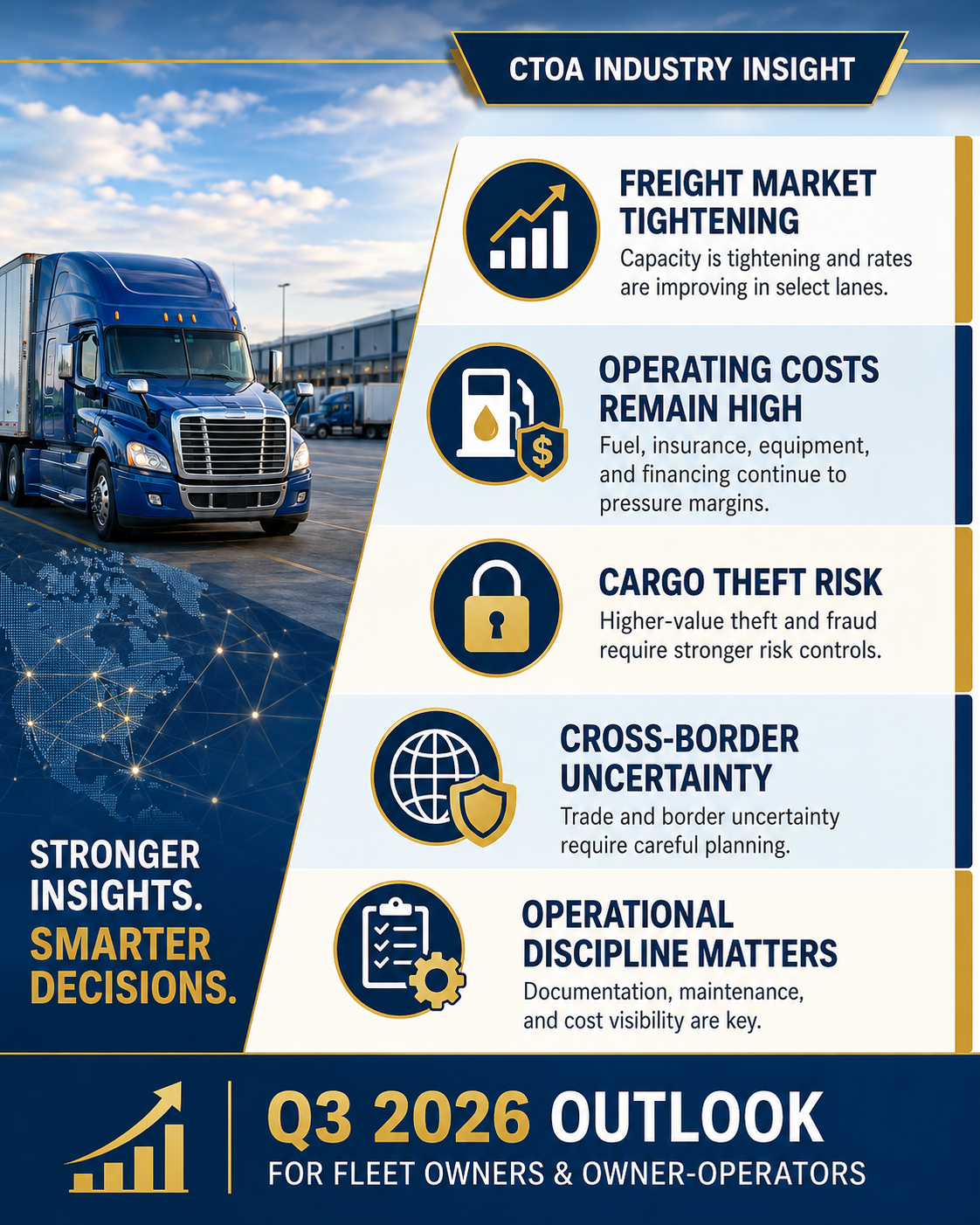
Industry Insight - CTOA - Canada Truck Operators Association

Logistics-sector-report-2026-CTOA.png

June 20, 2026

Industry Insight Series: Canada Truck Operators Association, Q3 2026 – July through September

Prepared for CTOA fleet owners, owner-operators and small carriers. Covering freight markets, regulatory environment, trade policy, operating costs, cargo security and practical steps for the next quarter.

Editor’s Note

The Canadian trucking industry sits at an inflection point. After a long period of compressed margins, volatile costs and intense competition, Q3 2026 arrives with signs of market tightening – but also with higher regulatory, insurance, fuel, equipment and cargo-security risk.

This report is written for the operators who are running the miles, not reading about them from a boardroom. The goal is to give CTOA members – fleet owners and owner-operators alike – a clear, practical view of where the market stands, what is coming in the next quarter, and what actions should be taken now.

Six Themes Defining Q3 2026

  • Freight market tightening is real, but uneven. Spot-market pressure, route-guide failures and tender rejection signals suggest less available capacity than during the 2023-2025 downcycle. The improvement is strongest for disciplined carriers with good documentation, equipment readiness and customer relationships.
  • This is a supply-side recovery, not a demand boom. Demand is not uniformly strong. Much of the rate pressure is being driven by carrier exits, operating-cost pressure, enforcement and reduced available capacity. Members should improve rates carefully, but continue to price every load by true cost.
  • Compliance and documentation remain business fundamentals. The strongest operators will be those with organized driver, equipment, dispatch, maintenance, insurance, payroll, tax and customer records. A clean file is now part of operational discipline, not just paperwork.
  • Cross-border planning faces CUSMA (USMCA) uncertainty. The six-year CUSMA (USMCA) joint review begins in 2026. A smooth extension would support stability, while prolonged negotiations would create recurring uncertainty for cross-border lanes and customer planning.
  • Cargo theft and fraud are rising in value and sophistication. CargoNet reported estimated U.S./Canada cargo theft losses near US$725 million in 2025, with average theft value up 36% to US$273,990. Carriers should review insurance limits, identity-verification procedures and parking/security protocols.
  • Operating discipline will decide who benefits. Diesel, insurance, equipment, financing, maintenance and payment delays continue to squeeze margins. The next quarter will reward operators who know their numbers, protect cash flow and maintain audit-ready records.

Freight Market Conditions: Tighter Than It Looks

North America’s freight market entered Q3 2026 with the surface appearance of stabilization, but with real structural tension underneath. For Canadian carriers – particularly small carriers and owner-operators who survived the 2023-2025 freight downcycle – some of that tension is beginning to work in their favour.

Spot Rates, Route-Guide Failures and Tender Rejections

Recent market updates describe a freight market that remains volatile and capacity-sensitive. FreightWaves reported that disruptions such as International Roadcheck quickly pushed tender rejections and spot rates higher, while C.H. Robinson reported that route-guide failures and tightening truckload capacity have become important signs of reduced slack in the market.

For CTOA members, the key point is that tender rejection data is primarily a U.S. truckload market signal, but it matters for Canadian carriers because North American freight lanes, cross-border capacity and shipper behaviour are connected. When available capacity tightens in the U.S., Canadian cross-border pricing, routing, broker behaviour and shipper expectations can change quickly.

▶ CTOA Member Implication

If you operate in spot or cross-border freight, your negotiating position has improved from the weakest period of the downcycle. Use this window to review lane pricing, fuel recovery and customer payment terms. Do not accept higher headline rates without confirming the load is profitable after fuel, empty miles, waiting time, insurance, maintenance and payment delay.

Contract and Spot Rates: Recovery With Caution

Contract and spot rates have been improving from the 2024-2025 trough. C.H. Robinson’s April 2026 market update forecasted 2026 dry van truckload costs up 17% year over year and refrigerated truckload costs up 16% year over year. Other News networks also reported Canadian spot-rate strength in spring 2026, including higher spot rates and a supply-driven recovery dynamic.

▶ CTOA Member Implication

Now is the time to review contract renewals and customer rates. The leverage exists, but it should be used strategically. Improve pricing on existing stable lanes before adding risky new lanes. A carrier can still lose money on a higher-paying load if the full cost is not calculated.

Intermodal and Modal Competition

When truckload capacity tightens, shippers often look to rail and intermodal alternatives. Reuters has reported that tighter truck capacity is giving U.S. railroads an opportunity to win back some freight. This is not necessarily a direct threat to every carrier, but it is a reminder that shippers will use all available options when truck pricing rises.

Members should maintain shipper relationships even when some freight temporarily shifts modes. Service reliability, communication and flexible capacity remain major advantages for trucking.

Compliance Is Now Part of Business Discipline

For small and mid-sized carriers, compliance should be treated as part of daily operations, not as a separate legal or political debate. The practical priority for Q3 is simple: keep records clean, current and easy to produce when needed.

Fleet owners should review driver files, equipment and maintenance records, insurance documents, permits, dispatch records, proof of delivery, payment records, contracts, payroll or contractor documentation where applicable, and customer communications. The goal is not to create fear, the goal is to reduce business risk, improve professionalism, and protect companies before small paperwork gaps become expensive operational problems.

▶ CTOA Member Implication

Every carrier should be able to answer three questions quickly: Are our files current? Can we prove how each load was dispatched, delivered and invoiced? Can management see compliance, maintenance and payment issues before they become a crisis?

Medium-Term Policy Direction

Transport Canada and other public agencies continue to focus on safety data, zero-emission trucking planning, technology, equipment transition and future regulatory frameworks. These are not immediate Q3 pressures for most small carriers, but they show where the industry is heading: better records, better systems, cleaner operations and stronger accountability.

The CUSMA (USMCA) Countdown: What It Means for Your Loads

2026 Joint Review: Three Possible Worlds

The CUSMA (USMCA) is designed to last 16 years, expiring in 2036 unless the parties agree to extend it. Article 34.7 requires Canada, the United States and Mexico to conduct a formal review at the six-year mark. If the parties agree to extend, the agreement can continue with greater certainty. If they do not, annual reviews can create recurring uncertainty.

Scenario A – Best Case
Extension and Stability: The parties agree to extend or maintain the agreement with modest adjustments. Cross-border planning remains stable and customer confidence improves.
Scenario B – Disruptive
Contentious Review: Negotiations become difficult, with pressure around autos, agriculture, procurement, digital trade or rules of origin. Cross-border shippers delay decisions.
Scenario C – Worst Case
Annual Uncertainty: No extension is confirmed and the agreement enters recurring review cycles. Carriers and shippers face planning uncertainty that can affect volumes and rate commitments.
▶ CTOA Member Implication

Cross-border operators should stress-test lane exposure before signing long-term commitments. Review which customers, routes, equipment and drivers depend heavily on U.S. trade flows. Build flexibility into pricing and contract language where possible.

Tariffs, Trade Friction and Lane Risk

Trade uncertainty can change freight flows quickly. Tariff pressure, customs complexity and customer hesitation can create strong rates on one lane and weak backhaul availability on another. Carriers should avoid looking only at the outbound rate; the full round trip must be profitable.

For Q3, domestic Canadian lanes may offer more planning stability than heavily exposed cross-border lanes. However, strong cross-border operators with disciplined paperwork, reliable equipment and customer relationships can still find opportunity.

The Margin Squeeze Continues

Equipment: The Tariff and Replacement-Cost Pressure

Tariff-related cost pressure may increase new commercial truck prices. S&P Global Mobility estimated tariff impacts could add roughly 9% to new truck prices and reduce demand by up to 17%. Some industry summaries have also cited potential Class 8 price increases around US$10,000 per unit, although this should be treated as an estimate rather than a fixed number.

For Canadian fleet owners considering equipment refreshes in 2026, the decision should be based on safety, reliability, revenue opportunity, financing cost and repair history. Delaying replacement may save capital in the short term, but keeping unreliable equipment can increase downtime, roadside risk and customer service failures.

▶ CTOA Member Implication

Track repair cost by unit, not only total repair cost. A truck that keeps moving but constantly breaks down may be quietly destroying margin. Review preventive maintenance schedules, inspection records and recurring repairs before Q3 freight demand increases.

Fuel, Insurance and Payment Delay

Diesel, insurance and financing costs remain major margin risks. Fuel volatility can erase the profit on a lane if fuel surcharge recovery is weak or delayed. Insurance renewals may also become more challenging as cargo theft, claims costs and compliance expectations rise.

Payment delay remains a structural problem for small carriers. Waiting 30, 60 or 90 days for payment forces many operators into factoring or high-cost borrowing. Members should track average days-to-payment by customer and avoid building growth around customers who consistently delay cash flow.

Cargo Theft: The Fastest-Rising Risk

Cargo theft risk is rising in value and sophistication. CargoNet reported that estimated losses reached nearly US$725 million in 2025, up 60% from 2024, while average theft value rose 36% to US$273,990. Thefts are increasingly tied to identity fraud, fictitious pickups, phishing, cloned domains, double brokering and strategic cargo theft.

Food and beverages, electronics, automotive parts, metals and retail goods remain attractive targets. Members should not assume that traditional cargo coverage is enough for modern fraud-based theft schemes.

▶ Three Questions for Your Insurance Broker – Before Q3

1. What is your current per-occurrence cargo limit, and does it reflect current average theft values?

2. Does your policy respond to strategic cargo theft, identity fraud, load interception and phantom carrier schemes?

3. Have you reviewed parking, seal, tracking, document and verification requirements in the past 12 months?

Q3 2026: Opportunities & Risks

Industry conditions can best be described as stabilization with structural turbulence. Freight pricing is improving in many areas, but the operating environment is more complex and more expensive than it was before the downcycle. The carriers positioned to gain ground in Q3 and Q4 are those who treat compliance, cash flow, safety, maintenance and cost visibility as core business functions.

Opportunities in Q3 2026

  • Rate recovery is accessible. Carriers with reliable service and clean documentation are in a stronger negotiating position than during the freight recession.
  • Compliance can become a competitive advantage. As enforcement increases, customers and brokers may prefer carriers with cleaner files, stronger documentation and predictable business practices.
  • Domestic lanes may provide planning stability. Given CUSMA (USMCA) review uncertainty, some carriers may benefit from balancing cross-border exposure with domestic lanes.
  • Technology and data are becoming essential. Small carriers should track cost per mile, lane profitability, customer payment history, maintenance cost by unit and empty miles.

Risks to Monitor

Risk Level What to Watch
USMCA Review High Contentious negotiations or annual uncertainty would be most disruptive for cross-border operators. Review lane mix and customer concentration.
Demand Softness Medium Freight tightening is largely supply-driven. If consumer or manufacturing demand weakens, rate momentum could soften.
Fuel Shocks Medium Diesel remains sensitive to global events. Review fuel surcharge recovery and avoid underpriced lanes.
Cargo Theft and Fraud High Rising theft values and identity-based fraud require stronger verification, insurance review and documentation.
Classification and Compliance Audits High Review contractor arrangements, driver files, T4A reporting, payroll records and employment-law risk with qualified advisors.
EV and Decarbonization Policy Monitor Not a Q3 crisis for most small fleets, but policy direction suggests equipment transition planning will become more important.
▶ CTOA Member Action Checklist

Before Q3, every member should review: real cost per mile, customer payment delays, profitable lanes, high-repair units, insurance limits, fuel surcharge recovery, compliance files, maintenance records, driver documentation and exposure to cross-border uncertainty.

Sources & Methodology

This industry insight report is prepared by the Canada Truck Operators Association for members and industry readers. It draws on public reporting and industry analysis available as of late June 2026. Market conditions can change quickly; members should consult qualified legal, financial, insurance and tax advisors before making material business decisions.



Driver-well-being-is-a-safety-issue-CTOA-for-Safety.jpg

June 20, 2026

Canada’s trucking industry depends on professional drivers who spend long hours on the road, away from their families, under constant pressure to deliver safely, professionally, and on time.

Too often, public discussions about trucking focus only on enforcement, compliance, or isolated incidents. Those issues matter, but they are not the whole story. If Canada wants safer roads and a stronger supply chain, driver wellbeing must become part of the national transportation conversation.

Driver mental health is not separate from road safety. It is connected to fatigue, stress, focus, decision-making, workplace pressure, and the conditions drivers face every day.

Long-haul drivers often deal with extended time away from home, irregular schedules, traffic, weather, loading delays, inspection pressure, customer expectations, rising costs, and public judgment. For many drivers, the job affects not only their own health, but also their families and personal lives.

Despite these pressures, drivers continue to show up. They move food, medicine, construction materials, retail goods, manufacturing parts, and the everyday products Canadians rely on. During the COVID-19 pandemic, truck drivers were widely recognized as essential workers. That respect should not disappear when public debate becomes difficult.

CTOA believes driver wellbeing must be treated as a serious safety and workforce issue.

A driver who is exhausted, stressed, unsupported, or constantly under pressure is not being set up for success. A safer trucking industry requires stronger training standards, better fatigue awareness, mental health support, fair enforcement, practical compliance education, and respect for the people behind the wheel.

This does not mean lowering standards. It means strengthening safety by understanding the real conditions of the job.

CTOA supports strong road safety standards, fair and consistent enforcement, better training oversight, and accountability for unsafe or non-compliant operators. At the same time, policy discussions must include the voices of drivers, owner-operators, small carriers, fleet operators, safety professionals, training experts, and industry stakeholders who understand the realities of the road.

Canada’s trucking industry should not be reduced to one narrow narrative. Safety is connected to training, fatigue, equipment maintenance, mental health, insurance pressure, operating costs, cargo theft, enforcement consistency, and the day-to-day pressures placed on drivers and operators.

Supporting driver wellbeing is not only the right thing to do.

It is a road safety issue, It is a workforce issue and It is a supply chain issue.

CTOA will continue advocating for practical, evidence-based solutions that support safer roads, stronger operators, respected drivers, and a more resilient trucking industry.

Together, we keep Canada moving.


CTOA-logo-truck-2.png

June 5, 2026

The future of trucking will not be strengthened by reducing it to a single narrative. It will be strengthened by understanding the full picture. Because Canada’s supply chain does not run on policy papers alone.

It is 3:47 in the morning.

Somewhere on Highway 401, a truck driver is finishing his second coffee, checking his mirrors, and merging onto an empty highway. He left home before his children woke up. He will not be there when they go to bed tonight. Maybe not tomorrow night either.

He is not on television, He is not sitting on a government panel and nobody is quoting him in policy debates.

Yet without him, grocery store shelves do not stay stocked, factories do not receive parts, and businesses across Canada cannot operate.

Behind every policy discussion about trucking is a real person. A driver,  an owner-operator, a small-business owner, a family trying to make a living in one of the most demanding industries in the country.

That is why Canada’s trucking policy debate needs a reset.

Because too much of the conversation is being conducted as though the industry has remained unchanged for the last fifteen years. It hasn’t, and that matters.

Fifteen years ago, most Canadians accepted that deliveries would take several days. E-commerce was a small part of retail activity. Few consumers expected real-time tracking. Very few expected groceries or household products delivered to their door within hours.

Today those expectations are routine, Consumers expect speed, Businesses expect precision and Supply chains operate in real time.

The transformation was driven by technology, changing consumer behaviour, and the rapid growth of digital commerce.

When Amazon changed how Canadians shop, it changed how freight moves. When Instacart changed how Canadians buy groceries, it changed supply chains and When food delivery platforms expanded, they created entirely new expectations around speed and convenience.

The trucking industry adapted to those changes. Dispatch systems became more sophisticated. Visibility requirements increased. Customers demanded tighter delivery windows and Freight markets became more competitive.

At the same time, operating costs continued to rise. Insurance and equipment costs increased. Regulatory requirements expanded and Labour shortages became more pronounced.

In many ways, trucking became the connective tissue of Canada’s modern economy.

Yet much of the public discussion still relies on assumptions and policy frameworks developed for a very different era. Bad diagnoses often lead to bad policy. 

If we want effective transportation policy, we must begin with an accurate understanding of the industry as it exists today. Too often, people talk about trucking without talking about the people who keep it moving. 

Carriers, Owner-operators, Fleets, Classifications.

But behind those terms are people.

An owner-operator is often someone who spent years saving for a down payment on a truck. Someone who took a financial risk believing that hard work and determination could build something meaningful. Someone who gets up before most Canadians are awake because their name is on the truck and their reputation is attached to every delivery.

Many of these entrepreneurs are newcomers to Canada.

For decades, trucking has been one of the most accessible pathways to entrepreneurship in this country. Many drivers arrived in Canada with little more than ambition and a willingness to work. They built businesses and created jobs, They bought homes and contributed to their communities.

Their stories deserve to be part of the conversation too.

One of the biggest misconceptions about trucking is that it is dominated by large corporations.

The reality is very different.

According to recent government  data, more than 83 per cent of trucking establishments employ fewer than five people. Behind many company names is not a corporate boardroom. It is a family business. A husband-and-wife operation, A first-generation entrepreneur. A small fleet trying to survive through freight downturns, rising insurance costs, increasing operating expenses, and intense competition.

These businesses form the backbone of Canada’s trucking sector. Their experiences deserve to be heard when policies affecting the industry are being developed.

There is another side of trucking that receives far less attention.

Mental health.

Truck driving can be one of the loneliest professions in Canada. Drivers spend days and sometimes weeks away from home. They work through difficult weather conditions. They face financial uncertainty. They carry enormous responsibility every time they get behind the wheel.

When freight rates decline, When equipment breaks down. When business costs rise and when personal challenges emerge.

Many drivers face those pressures alone.

Loneliness, financial stress, and long periods away from family are realities that cannot be measured on a balance sheet, but they have very real consequences.

As Canada continues to have important conversations about workplace wellness and mental health, trucking should not be left out of that discussion.

Mental health is not separate from safety. Mental health is not separate from performance and mental health is not separate from sustainability.

They are all connected.

Acknowledging the realities of trucking should never be confused with lowering expectations. Safety must remain non-negotiable. The overwhelming majority of professional drivers understand this better than anyone.

Every day they operate equipment weighing tens of thousands of kilograms while sharing the road with families and communities. They understand the consequences of mistakes.

Most carriers invest heavily in training, maintenance, compliance programs, and safety systems because they understand what is at stake.

Accidents cost lives, accidents damage businesses, add to insurance costs and ratings and Accidents affect entire communities.

The challenge for policymakers is not choosing between safety and sustainability.

The challenge is ensuring both.

At CTOA, we have made safety, compliance, mental health awareness, and professional development key priorities. Through industry events, training sessions, and stakeholder engagement, we continue to encourage practical solutions that improve safety outcomes while supporting the long-term sustainability of the sector. In recent months, CTOA has brought together drivers, owner-operators, fleet owners, law enforcement, insurers, safety professionals, and industry experts in Montréal and Brampton to discuss practical solutions around safety, compliance, cargo theft prevention, driver well-being, and the future of the industry.

The trucking industry of 2040 will not look like the trucking industry of today.

Artificial intelligence is already transforming route planning, fleet management, predictive maintenance, compliance monitoring, and logistics operations.

Automation will continue to evolve. Electric vehicle technologies will expand and Data-driven decision-making will become standard.

Many of today’s drivers may be the last generation to experience trucking exactly as we know it.

The question is not whether change is coming, The question is whether we are preparing people for it.

The workforce is aging and experienced drivers are retiring.

Fewer young Canadians are entering the profession. The lifestyle is demanding and the public perception is often negative.

The uncertainty can be significant.

If Canada wants a strong supply chain twenty years from now, we need to make trucking a profession that attracts the next generation.

That means supporting entrepreneurship. That means investing in mental health. That means embracing technology and that means creating fair and sustainable opportunities for both drivers and businesses.

Most importantly, it means listening to the people who do the work every day. There are legitimate concerns within the trucking industry.

Issues related to labour standards, safety, compliance, and enforcement deserve attention. Companies that break the law should be held accountable.

Drivers deserve fair treatment, The public deserves safe roads.

None of that is controversial.

But meaningful solutions require a complete understanding of the industry. Policy discussions should include drivers, owner-operators, carriers, brokers, shippers, labour representatives, insurers, safety experts, training providers, and regulators.

No single organization or stakeholder group can fully represent an industry as diverse and complex as trucking.

The future of trucking will not be strengthened by reducing it to a single narrative. It will be strengthened by understanding the full picture.

Because Canada’s supply chain does not run on policy papers alone.

It runs on diesel, data, determination, and the decisions of people who are rarely in the room when those decisions are made about them.

The future of trucking will not be built solely in boardrooms, committee hearings, or government offices. It will be built by listening to the people who live these realities every day. The people who keep Canada moving deserve more than to be talked about.

They deserve to be heard.

Tej Dulat is Director of Government & Public Affairs for the Canada Truck Operators Association (CTOA). CTOA represents drivers, owner-operators, small and mid-sized carriers, brokers, and industry partners across Canada and advocates for safety, professionalism, fair competition, and practical solutions that strengthen Canada’s trucking industry and supply chain.


truck-3.jpg

March 23, 2026

Market Analysis & Strategic Outlook (2026–2027)

After two years of oversupply and compressed margins, Q1 2026 shows early evidence of a tighter, more disciplined carrier base. The next 18 months will reward carriers who manage capital carefully, adapt to regulatory change, and monitor a set of converging trade, infrastructure, and workforce pressures that are reshaping the industry’s operating environment.


Section I: Current Market Conditions


The excess capacity that weighed on Canadian freight markets through 2024 and into 2025 is beginning to clear. This is not a demand-driven recovery, it reflects the exit of smaller, undercapitalized carriers who were unable to absorb sustained cost increases across insurance, fuel, financing, and maintenance.

The result is a leaner industry than existed two years ago. The remaining carrier base is, on balance, better capitalized and more operationally disciplined. That shift is beginning to reflect in spot rates, which have stabilized and shown early signs of a modest recovery in several key corridors.

4-6%
SPOT RATE RECOVERY

Year-over-year rate improvement in key Canadian corridors as of Q1 2026, per industry analyst consensus. Recovery remains uneven across sectors and regions.

10-15%
CAPACITY SHORTFALL

Driver vacancy rate reported by a segment of CTOA member carriers in early 2026, adding a structural supply constraint alongside equipment-side contraction.

 
The persistent challenge is what analysts call a cost-revenue squeeze: Operating expenses, particularly insurance premiums and maintenance labour, continue to rise faster than freight rates. Carriers that have survived this cycle are those who controlled variable costs aggressively. That discipline will remain a competitive differentiator through 2027.
 
Market Signals – Q1 2026
  • Operating authority cancellations have accelerated as smaller fleets exit under sustained margin pressure.
  • Spot rates stabilizing, modest early recovery in Toronto-Montreal and Toronto-Calgary corridors.
  • Used equipment demand rising as new truck pre-purchases begin to build ahead of 2027 regulatory changes.
  • Insurance premiums remain elevated, cargo theft is contributing materially to claims costs in the GTA/Peel corridor.
  • 11000 plus transport driver positions were vacant in Canada as of Statistics Canada Q3 2025 – a structural, not cyclical, shortage.

Section II – Two Developments to Watch in 2026


Two distinct developments will materially affect Canadian freight flows this year. Both carry meaningful uncertainty and warrant closer attention from carriers than they have received so far.


The Gordie Howe International Bridge

Canada’s most significant trade infrastructure investment in decades is approaching its opening. Construction of the Windsor-Detroit crossing is complete. As of March 2026, the bridge is in its testing and commissioning phase, with toll rates officially announced on March 11. Commercial vehicle tolls are set at US$8.75 / CA$12 per axle, materially lower than the Ambassador Bridge’s current rate of US$20 per axle. The U.S. Department of Homeland Security formally designated the crossing as a Class A port of entry effective March 2, 2026.

No firm opening date has been confirmed as of the publication of this report. The Windsor-Detroit Bridge Authority has indicated a spring 2026 target, contingent on completion of quality reviews and readiness of border agencies on both sides.

Political Risk – Monitor Closely

In February 2026, U.S. President Donald Trump raised concerns regarding the bridge’s toll structure and construction materials. Canadian officials, including Prime Minister Carney, addressed these claims directly. The threat has not been formally withdrawn. Members with significant Windsor-Detroit exposure should monitor this situation before building the new crossing into routing and scheduling plans. CTOA will issue an advisory when an opening date is confirmed.

If and when the bridge opens on the currently projected timeline, carriers can reasonably expect: reduced congestion at the Ambassador Bridge, more predictable border processing times, a competitive toll environment, and a direct Highway 401 to Interstate 75 connection that eliminates the current city-street routing on the Canadian side.

“About US$250 billion in goods cross the Detroit-Windsor corridor annually. CBP projects the new bridge will reduce average crossing times by up to 30 percent once fully operational.”  “U.S. Customs and Border Protection, Federal Register, January 2026″


The CUSMA/USMCA Joint Review – July 1, 2026

The mandatory six-year review of the Canada-United States-Mexico Agreement begins July 1, 2026. This is a structured joint review, not a formal renegotiation. The agreement does not expire or automatically change on that date; if parties do not agree to extend it, the process shifts to annual reviews. The agreement remains in force throughout.

That said, the current U.S. administration has signalled it intends to use this review to seek material changes, and the broader trade environment, including the 25% tariffs imposed on Canada in early 2025 and subsequent partial relief, underscores that cross-border freight operators are navigating genuine policy volatility. The tariff situation has shifted multiple times in 2025 and 2026; members with cross-border exposure should verify their specific commodity’s current tariff status with a customs broker rather than relying on any fixed figures.

July 1

CUSMA Review Begins
Mandatory six-year joint review. Agreement remains in force. Outcome uncertain under current U.S. administration.

Rules of Origin

Key Compliance Area
Auto parts and steel classifications will face the most scrutiny. Review your commodity compliance before July.

~$250B+

Annual Corridor Value

The Windsor–Detroit corridor is a critical trade gateway, within over $1.3 trillion in annual Canada–U.S. trade.

Cross-border fleets should use the period between now and July to review rules of origin compliance, particularly for automotive components and steel products, and to strengthen customs documentation practices. This is preparation, not alarm.

Section III – The 2027 Emissions Transition


The most significant equipment cost event in years is approaching. The U.S. EPA’s 2027 greenhouse gas and low-NOx standards for heavy-duty vehicles will drive a step change in new truck pricing. Because North American original equipment manufacturers produce to a single continental standard, Canadian carriers purchasing Class 8 trucks will face the same cost increase as their U.S. counterparts.
Current industry estimates, from CDK Global and truck manufacturer guidance,  project new 2027-compliant trucks at approximately $20,000–$25,000 more per unit than equivalent 2026 models, primarily due to more complex aftertreatment systems. These systems also carry meaningful maintenance implications during their early years in service.
 

What Members Need to Know – 2027 Emissions Rule

  1. The rule is a U.S. EPA rule: Canada’s Heavy-Duty Vehicle GHG Regulations run in parallel but on a separate schedule, verify with your dealer what applies to your fleet
  2. The EPA signaled in early 2026 that a revised proposal is expected in spring 2026, which could reduce per-unit cost impact while maintaining the 2027 start date
  3. Members should avoid locking in large pre-buy orders until the revised rule is finalized (expected Q2/Q3 2026), as cost structures may change
  4. The pre-buy cycle (rush to purchase 2026-spec trucks before Q4) is real, but early movers risk buying ahead of potential regulatory adjustments
  5. Used equipment values are expected to rise as demand for 2026-spec diesel trucks increases, relevant for fleets considering disposals this year

The practical planning recommendation is clear: evaluate your fleet replacement schedule now, but avoid reactive purchasing before the revised EPA rule is published. The window for informed decision-making is approximately Q2 2026.

Section IV – Regulatory & Workforce Pressures


Tax Compliance – T4A Enforcement Is Live

The CRA’s moratorium on T4A penalties for independent contractors in the trucking sector has ended. The reporting deadline for the 2025 tax year, T4A Box 048 for fees paid to Canadian Controlled Private Corporations over $500, passed on Feb 28th, 2026 (March 2, 2026). Enforcement is active. This is not a future concern, it is the current operating reality.

CTOA’s position has been consistent: comply with reporting requirements, and expect CTOA to ensure enforcement is applied fairly & consistently. If you received a compliance notice and have not yet responded, contact info@thectoa.ca immediately.

Workforce – A Structural Shortage, Not a Cyclical One

Statistics Canada reported 11000 plus vacant transport truck driver positions in Q3 2025. Multiple CTOA member carriers report current vacancy rates of 10% to 15%. This is not a short-term matching problem, it reflects an aging driver demographic, insufficient domestic training pipeline, and in CTOA’s assessment, retention barriers including discriminatory treatment and online hostility toward racialized and newcomer drivers that is driving experienced workers out of the industry.

Immigration pathways remain a material component of driver supply. Members relying on workers through temporary permit programs should verify current Express Entry draw categories for transport occupations directly with an immigration lawyer or through IRCC, as program criteria and draw schedules evolve regularly. CTOA will share updates as IRCC confirms 2026 draw schedules.

Cargo Theft – A Growing Operational and Financial Risk

North American cargo theft losses reached an estimated $725 million in 2025, with hundreds of documented incidents in Canada and the United States in Q3 2025 alone. Criminal networks have adopted more sophisticated methods, including fictitious carrier identities and fraudulent load authorizations. The GTA and Peel Region represent a disproportionate concentration of incidents.

CTOA launched a national freight security initiative in March 2026 to address this through real-time information sharing, and coordinated engagement with law enforcement. The initiative is operational and member participation is open. Contact info@thectoa.ca for details.

Section V – Strategic Priorities for 2026


The following recommendations reflect current market and regulatory conditions. They are intended as a framework for decision-making, not a prescriptive plan.


01

Evaluate Fleet Replacement Timelines –

But Wait on Large Orders

Know your replacement schedule. Do not commit to large pre-buy orders before the EPA publishes its revised 2027 rule in Q2/Q3 2026. Monitor the market carefully through summer.

02

Prepare for the Windsor-Detroit Corridor Shift

Once the Gordie Howe Bridge opens, toll competition and routing changes will affect lane economics. Build familiarity with the new crossing now.

03

Review Cross-Border Compliance Before July 1

Audit rules of origin documentation. Engage a customs broker if needed. Do not wait for the CUSMA review to trigger action.

04

Strengthen Cargo Security Protocols

Implement two-step verification for load releases. Join CTOA’s freight security initiative to reduce risk and insurance exposure.

05

Protect Margins Through Cost Discipline

Focus on insurance, fuel efficiency, and maintenance optimization. Benchmark against peers in your operating corridor.

06

Engage With CTOA’s Policy Work

Policy changes around independent driver classification and enforcement are underway. Member participation ensures your voice is represented.

CTOA Outlook :- 2026–2027

The conditions ahead do not reward the fastest or the largest. They reward carriers who manage their balance sheets carefully, anticipate regulatory change before it becomes a crisis, and operate with the discipline that the last two years of margin pressure have, of necessity, installed.

The carriers who exit 2027 in a stronger position than they entered 2026 will be those who used this transition period to prepare, not those who moved reactively once the environment shifted.

CTOA will continue to monitor and report on each of these files as they develop. The Gordie Howe Bridge opening, the EPA revised rule, and the CUSMA review are all active situations. Members should expect direct updates from CTOA as material developments occur.

Editorial note: This report synthesizes publicly available market data, regulatory filings, and CTOA’s direct advocacy experience. Where forward projections are cited, they represent the current consensus of industry analysts and may evolve as new information emerges, including the U.S. EPA’s forthcoming revised emissions rule expected in Q2/Q3 2026. Members should verify time-sensitive regulatory and tariff details directly with their advisors before making capital commitments.


portfolio_01-1280x853.jpg

March 11, 2026

CTOA Industry Insight / Topic: Insurance, Safety, Policy

The Canadian Truck Operators Association (CTOA) represents trucking operators, fleet owners, brokers, and industry stakeholders across Canada. As discussions continue around rising insurance premiums in the trucking sector, it is important to examine the broader factors influencing transportation risks and insurance costs.

Recent industry conversations have highlighted accident severity and claims costs as key contributors to rising premiums. While these factors certainly play a role, the issue is far more complex and reflects significant economic, infrastructure, and transportation changes that have taken place over the past decade.

A balanced and comprehensive understanding of these factors is essential to developing policies that support both road safety and a resilient national supply chain.

Growth in Traffic and Road Congestion

Canada has experienced significant population growth and economic expansion over the past decade. As cities expand and economic activity increases, the number of vehicles on the road has also grown considerably.

Passenger vehicles, delivery vans, ride‑share vehicles, and commercial trucks have all increased. However, in many regions, road infrastructure has not expanded at the same pace.

Major freight corridors such as the Greater Toronto Area, Montreal, Vancouver, and Calgary are experiencing increasing congestion. Higher traffic density naturally increases the likelihood of road incidents for all road users, not just commercial trucks.

Understanding these broader transportation trends is important when evaluating safety risks and insurance claims across the sector.

Expanding Freight Demand and Supply Chain Growth

Over the past decade, Canada’s supply chain has undergone significant transformation. The rapid growth of e‑commerce, national distribution networks, and just‑in‑time delivery systems has increased demand for freight transportation.

Retailers, manufacturers, and logistics companies rely heavily on trucking to move goods efficiently across the country. As freight demand increases, trucks spend more time on the road and operate across increasingly complex logistics networks.

Trucking remains the backbone of Canada’s supply chain, ensuring that businesses and consumers receive essential goods every day.

Rising Equipment and Repair Costs

Another major factor influencing insurance claims is the rising cost of modern trucking equipment and repairs.

Today’s commercial trucks are significantly more advanced than they were a decade ago. They include complex electronics, safety sensors, and advanced driver‑assistance technologies. While these innovations improve safety and operational efficiency, they also increase the cost of repairs.

In addition, higher labour costs for technicians, global supply chain disruptions, and more expensive replacement parts have contributed to rising repair expenses.

As a result, even relatively minor collisions can generate significantly higher claim values than in the past.

Economic Pressures Across the Transportation Sector

The trucking industry has also experienced broader economic pressures in recent years. Rising fuel prices, higher financing costs for vehicles, inflation in parts and maintenance, and increased labour costs have all affected operating expenses.

These broader economic conditions influence the cost of claims and the financial models used within the insurance sector.

Understanding these pressures helps provide a more complete picture of the challenges faced by both trucking operators and insurers.

Road Safety Is a Shared Responsibility

Road safety is influenced by many factors across the entire transportation ecosystem. Traffic congestion, infrastructure design, driver behaviour across all vehicle types, weather conditions, and road conditions can all contribute to collisions.

For this reason, improving road safety requires a system‑wide approach that involves government, transportation planners, insurers, and industry stakeholders.

Focusing on the broader transportation environment helps ensure that policies address the root causes of safety risks rather than attributing responsibility to a single segment of the industry.

Technology and Safety Improvements

The trucking industry has made significant investments in technology to improve safety and reduce operational risks.

Many fleets are adopting tools such as:

  • telematics systems
  • dash cameras
  • driver monitoring technologies
  • advanced safety management programs

These technologies help companies better understand driving behaviour, identify safety risks early, and strengthen training programs for drivers. Over time, these investments can contribute to safer operations and improved risk management across the industry.

The Importance of Collaboration

Rising insurance costs affect the entire supply chain, including trucking companies, insurers, retailers, manufacturers, and consumers.

The Canadian Truck Operators Association (CTOA) believes that addressing these challenges requires constructive collaboration between government, insurers, and industry stakeholders.

Policy discussions should focus on:

  • improving transportation infrastructure
  • strengthening safety programs and driver training
  • addressing insurance fraud and cargo theft
  • supporting the adoption of safety technologies
  • ensuring transparency and stability in insurance markets

A collaborative approach will help ensure that policies support both road safety and a stable, efficient supply chain.

Key Industry Trends Influencing Insurance Costs

Several long‑term transportation trends help explain the changing insurance environment:

  • Vehicle growth: Canada’s total registered vehicles increased from roughly 23 million in 2013 to over 26 million in 2022 (Statistics Canada).
  • Urban congestion: Drivers in major freight corridors such as the Greater Toronto Area lose over 100 hours annually due to traffic congestion.
  • Rising truck values: A modern heavy‑duty commercial truck can now cost $200,000–$250,000, significantly higher than a decade ago.

These broader transportation trends illustrate why insurance risk and claim costs must be viewed within the context of a growing and increasingly complex transportation network.    (Sources: Statistics Canada, transportation studies, and industry market data.)

Supporting a Strong and Sustainable Trucking Industry

Trucking remains essential to Canada’s economy. From food and consumer goods to industrial materials and medical supplies, most products rely on trucking at some point in their journey.

Ensuring the long‑term sustainability of the trucking sector is therefore critical for the stability of Canada’s supply chain.

By examining the full range of factors influencing insurance costs and working together across sectors, policymakers and industry leaders can develop balanced solutions that support both economic growth and safer roads for all Canadians.

Canadian Truck Operators Association (CTOA)
Supporting trucking operators and strengthening Canada’s supply chain.