22 - CTOA - Canada Truck Operators Association

Bring to the table win-win survival strategies to ensure proactive domination. At the end of the day, going forward, a new normal that has evolved from generation.
Cargo-theft.jpg

August 22, 2026

CTOA calls for immediate customs clarity, targeted relief and protection from unrecoverable freight costs

OTTAWA, August 22, 2026: The Canada Truck Operators Association (CTOA) is calling for immediate customs guidance and targeted support for Canada’s trucking sector after Canada–U.S. trade negotiations ended without an agreement and new 50% U.S. tariffs took effect early Saturday.

The tariffs apply to approximately C$20 billion in Canadian exports, including selected dairy and alcoholic beverages, building materials, furniture, electronics, packaging, machinery, clothing and sporting goods.

Prime Minister Mark Carney has announced that Canada will match the U.S. tariffs “dollar for dollar” and introduce further support for affected Canadian workers and businesses. However, details concerning Canada’s counter-tariff product list, implementation date and treatment of goods already in transit have not yet been released.

CTOA recognizes the federal government’s responsibility to defend Canadian workers, businesses and national interests. Canada’s response must also protect the small to mid size carriers and owner-operators responsible for moving goods across the border and throughout the domestic economy.

“Small carriers and owner-operators are often the first businesses to feel the effects of a trade disruption, but among the last to be considered for relief,” said Tej Dulat, Director of Government and Public Affairs for CTOA. “When a shipment is cancelled, rejected or delayed at the border, the truck still has operating costs. The driver must still be paid, fuel has already been purchased, and the carrier may be left with detention, storage, redelivery and empty-mile expenses.”

CTOA is asking the federal government to:

  • Immediately publish the products covered by Canada’s countermeasures, their effective time, applicable tariff classifications and treatment of shipments already in transit.
  • Include small carriers and owner-operators in federal tariff-relief and business-support programs.
  • Recognize trucking losses arising from cancelled loads, reduced export volumes, detention, storage, empty repositioning, delayed payments and customer insolvencies.
  • Work with importers, exporters and customs brokers to establish clear responsibility for border-related costs.
  • Provide advance certainty before the federal four-cent-per-litre diesel excise-tax relief is scheduled to end after September 7.

Canadian carriers should not become the default financiers of customs disputes between governments, importers and exporters.

CTOA is advising carriers moving tariff-sensitive freight to obtain written instructions from importers or customs brokers, confirm responsibility for detention and redelivery costs, preserve shipment and border records, and avoid making independent representations concerning whether a customer’s goods are exempt from duties.

“Trucking cannot absorb every cost created by sudden changes in trade policy,” Dulat added. “Canada must protect its national interests while ensuring that responsible carriers, owner-operators and professional drivers do not become collateral damage in an escalating tariff dispute.”

CTOA will continue monitoring federal customs guidance, counter-tariff announcements, border operations and business-support measures. The association will provide further recommendations as official implementation details become available.

About the Canada Truck Operators Association

The Canada Truck Operators Association represents small and mid-sized carriers, owner-operators, independent operators and professional drivers. CTOA advocates for safe roads, fair and consistent enforcement, responsible business practices and public policies that recognize trucking’s essential role in Canada’s economy and supply chains.

Media contact:
Jas Kaur
Canada Truck Operators Association
jas.kaur@thectoa.ca


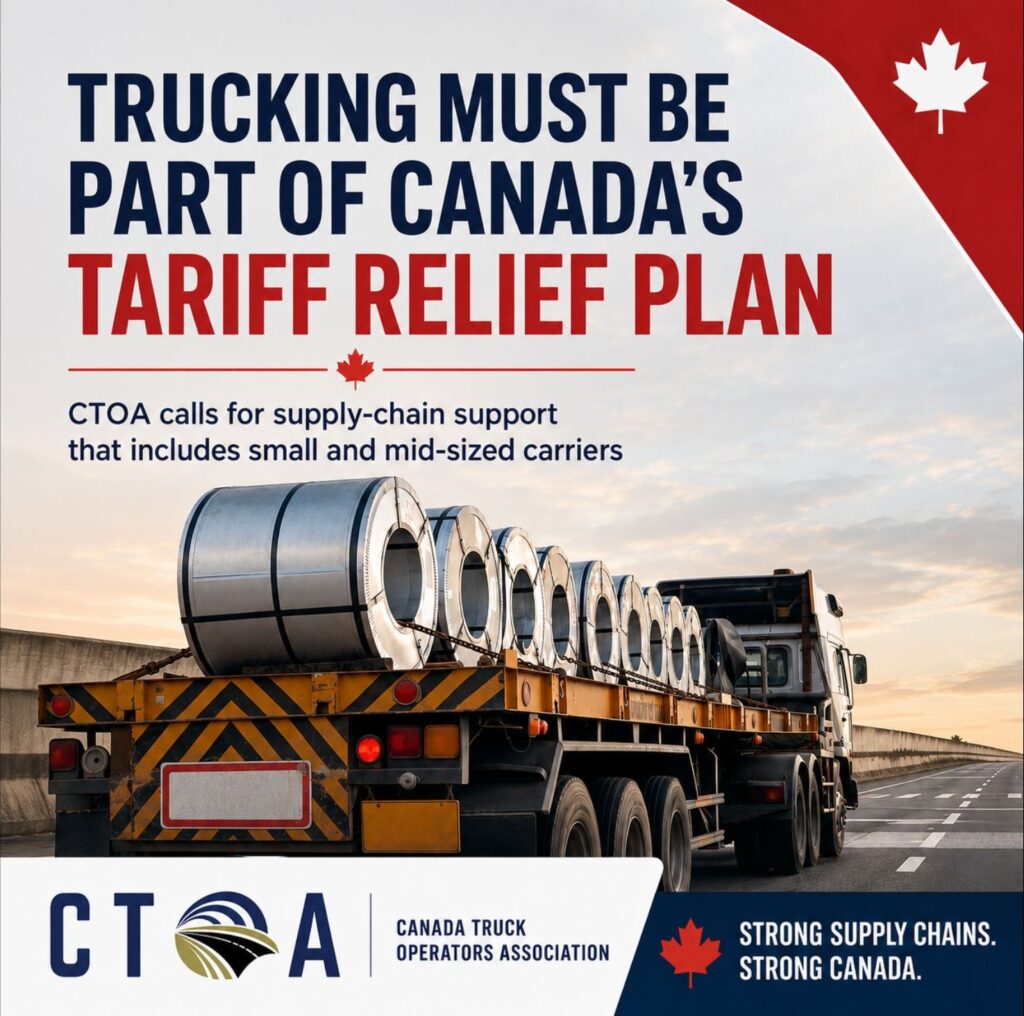
TRUCKING-MUST-BE-PART-OF-CANADAS-TARIFF-RELIEF-PLAN-1280x1270.jpg

August 11, 2026

National association says freight-cost relief must reflect the sector that moves most of Canada’s domestic freight and is overwhelmingly made up of small businesses

TORONTO, ON / August 11, 2026: The Canada Truck Operators Association (CTOA) is welcoming the federal government’s new $100-million freight rebate program to support Canadian steel producers, while calling on Ottawa to ensure Canada’s trucking industry is included in future tariff-relief and supply-chain support measures.

The federal program will rebate 50% of eligible freight costs for Canadian steel products shipped between provinces and territories by rail or marine transportation.

CTOA supports federal action to help Canadian industries respond to U.S. tariff pressure and strengthen domestic supply chains. However, the association says the announcement raises an important policy question: if the goal is to make Canadian products more competitive and improve interprovincial trade, why is trucking not included?

“Trucking is a critical part of Canada’s domestic freight system,” said Tej Dulat, Director of Government and Public Affairs for CTOA. “As the federal government works to protect Canadian industries from tariff impacts and strengthen internal trade, trucking should be part of the national supply-chain response.”

According to federal industry data, domestic freight in Canada moves primarily by truck. The trucking sector is also overwhelmingly made up of small businesses. In 2025, 83.4% of truck transportation employer establishments had fewer than five employees.

CTOA says this matters because small and mid-sized trucking companies, owner-operators, and carriers are already facing serious economic pressures, including rising operating costs, insurance challenges, equipment costs, border uncertainty, and tariff-related impacts on the industries they serve.

“When steel, manufacturing, construction, agriculture, retail, and other sectors face cost pressure, trucking feels that pressure directly,” Dulat said. “Carriers do not operate outside the economy. They are part of every supply chain Ottawa is trying to protect.”

CTOA is not opposing support for rail or marine transportation. The association recognizes that all modes play an important role in Canada’s transportation network. However, CTOA says federal relief measures must reflect how goods actually move across the country, including first-mile, middle-mile, and final-mile transportation by truck.

“Rail and marine are important, but most supply chains still depend on trucks at some point,” Dulat said. “Leaving trucking out risks overlooking the small businesses that connect factories, warehouses, ports, rail yards, construction sites, farms, retailers, border crossings, and communities.”

CTOA is calling on the federal government to consult directly with the trucking sector as it implements current freight-relief programs and considers additional support for other tariff-affected sectors, including lumber and forestry..

The association is also urging Ottawa to consider targeted measures that support small and mid-sized carriers and owner-operators, including freight-cost relief, fuel-cost support, insurance-cost discussions, supply-chain resilience funding, and practical programs that recognize the role of trucking in interprovincial trade.

“Canada needs strong steel, strong manufacturing, strong rail, strong marine transportation, and strong trucking,” Dulat said. “A resilient Canadian economy depends on every part of the supply chain working together.”

CTOA says it will continue advocating for drivers, owner-operators, small and mid-sized carriers, brokers, dispatchers, safety professionals, and transportation businesses that keep Canada’s economy moving.

About CTOA

The Canada Truck Operators Association is a national transportation industry association representing drivers, owner-operators, small and mid-sized carriers, fleet owners, brokers, dispatchers, and transportation stakeholders. CTOA advocates for road safety, fair rules, practical compliance, supply-chain resilience, stronger communication with government, and policies that reflect the realities of Canada’s trucking industry.

Media Contact

Canada Truck Operators Association
Email: info@thectoa.ca
Website: www.thectoa.ca