transportation - CTOA - Canada Truck Operators Association

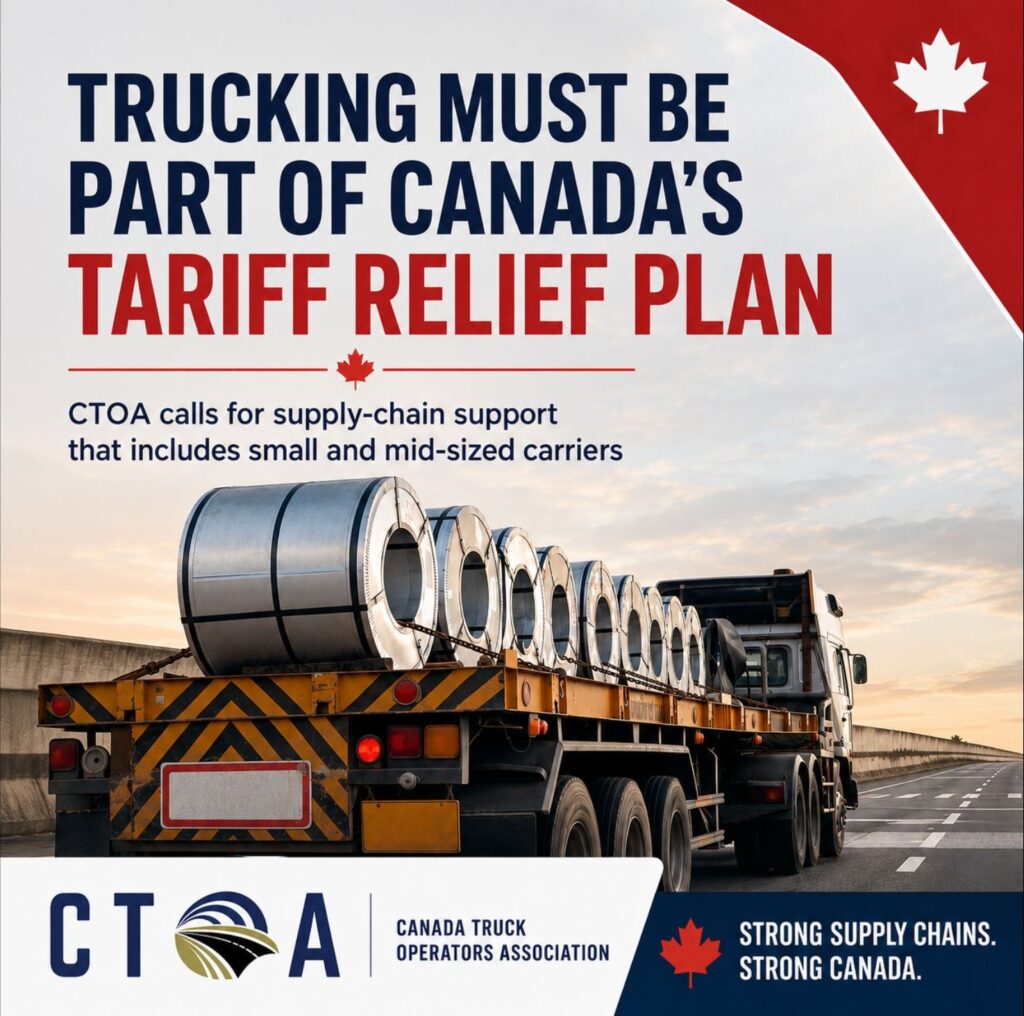
TRUCKING-MUST-BE-PART-OF-CANADAS-TARIFF-RELIEF-PLAN-1280x1270.jpg

August 11, 2026

National association says freight-cost relief must reflect the sector that moves most of Canada’s domestic freight and is overwhelmingly made up of small businesses

TORONTO, ON / August 11, 2026: The Canada Truck Operators Association (CTOA) is welcoming the federal government’s new $100-million freight rebate program to support Canadian steel producers, while calling on Ottawa to ensure Canada’s trucking industry is included in future tariff-relief and supply-chain support measures.

The federal program will rebate 50% of eligible freight costs for Canadian steel products shipped between provinces and territories by rail or marine transportation.

CTOA supports federal action to help Canadian industries respond to U.S. tariff pressure and strengthen domestic supply chains. However, the association says the announcement raises an important policy question: if the goal is to make Canadian products more competitive and improve interprovincial trade, why is trucking not included?

“Trucking is a critical part of Canada’s domestic freight system,” said Tej Dulat, Director of Government and Public Affairs for CTOA. “As the federal government works to protect Canadian industries from tariff impacts and strengthen internal trade, trucking should be part of the national supply-chain response.”

According to federal industry data, domestic freight in Canada moves primarily by truck. The trucking sector is also overwhelmingly made up of small businesses. In 2025, 83.4% of truck transportation employer establishments had fewer than five employees.

CTOA says this matters because small and mid-sized trucking companies, owner-operators, and carriers are already facing serious economic pressures, including rising operating costs, insurance challenges, equipment costs, border uncertainty, and tariff-related impacts on the industries they serve.

“When steel, manufacturing, construction, agriculture, retail, and other sectors face cost pressure, trucking feels that pressure directly,” Dulat said. “Carriers do not operate outside the economy. They are part of every supply chain Ottawa is trying to protect.”

CTOA is not opposing support for rail or marine transportation. The association recognizes that all modes play an important role in Canada’s transportation network. However, CTOA says federal relief measures must reflect how goods actually move across the country, including first-mile, middle-mile, and final-mile transportation by truck.

“Rail and marine are important, but most supply chains still depend on trucks at some point,” Dulat said. “Leaving trucking out risks overlooking the small businesses that connect factories, warehouses, ports, rail yards, construction sites, farms, retailers, border crossings, and communities.”

CTOA is calling on the federal government to consult directly with the trucking sector as it implements current freight-relief programs and considers additional support for other tariff-affected sectors, including lumber and forestry..

The association is also urging Ottawa to consider targeted measures that support small and mid-sized carriers and owner-operators, including freight-cost relief, fuel-cost support, insurance-cost discussions, supply-chain resilience funding, and practical programs that recognize the role of trucking in interprovincial trade.

“Canada needs strong steel, strong manufacturing, strong rail, strong marine transportation, and strong trucking,” Dulat said. “A resilient Canadian economy depends on every part of the supply chain working together.”

CTOA says it will continue advocating for drivers, owner-operators, small and mid-sized carriers, brokers, dispatchers, safety professionals, and transportation businesses that keep Canada’s economy moving.

About CTOA

The Canada Truck Operators Association is a national transportation industry association representing drivers, owner-operators, small and mid-sized carriers, fleet owners, brokers, dispatchers, and transportation stakeholders. CTOA advocates for road safety, fair rules, practical compliance, supply-chain resilience, stronger communication with government, and policies that reflect the realities of Canada’s trucking industry.

Media Contact

Canada Truck Operators Association
Email: info@thectoa.ca
Website: www.thectoa.ca


Safety-training.jpg

July 23, 2026

Association calls for decisive enforcement against unsafe, fraudulent, and chameleon carriers, while warning that one-size-fits-all compliance burdens could harm responsible small and mid-sized businesses

Mississauga, ON, July 23, 2026:- The Canada Truck Operators Association is calling for tougher, smarter, and more targeted enforcement against unsafe, fraudulent, and chameleon carriers, while urging governments to ensure that new compliance frameworks do not unintentionally punish responsible small and mid-sized trucking businesses.

CTOA says Canada needs stronger road safety, better inter-agency coordination, and real consequences for operators who deliberately evade safety, labour, tax, insurance, and compliance obligations. However, the association says enforcement must be built around the actual structure of Canada’s trucking industry, where most employer establishments are micro or small businesses.

“Responsible operators should be the first to demand action against bad actors,” said Tej Dulat, Director of Government & Public Affairs at CTOA. “Unsafe carriers, chameleon operations, and fraudulent operators put lives at risk, exploit workers, damage public confidence, and make every honest trucking business look suspect. They should be targeted decisively. But governments must also ensure that the response does not become a blanket compliance burden that only large fleets can afford to manage.”

According to federal industry data, 83.4% of employer establishments in Canada’s truck transportation sector are micro businesses with fewer than five employees, while 16.1% are small businesses. CTOA says any new inspection, audit, procurement, or compliance framework must be designed with that reality in mind.

“Canada does not have a shortage of rules,” said Dulat. “The challenge is making sure enforcement reaches the operators who are actually breaking them. Adding more paperwork for a responsible family-run fleet does not catch a chameleon carrier. It only makes it harder for a legitimate small business to survive.”

CTOA says responsible small and mid-sized carriers support safer roads and fair enforcement. Many of these businesses are family-run operations where owners are directly involved in dispatch, maintenance, hiring, insurance, payroll, safety, compliance, customer service, and daily operations. They serve local communities, regional routes, rural areas, cross-border lanes, and supply-chain needs across every province.

The association says stronger oversight must be paired with clear guidance, practical education, fair implementation timelines, and tools that help responsible operators comply.

“Compliance should not be a guessing game,” said Dulat. “If governments want stronger outcomes, then small and mid-sized carriers need clear expectations, practical support, and a fair opportunity to meet the standard. Enforcement must separate those who are trying to comply from those deliberately avoiding the law.”

CTOA is calling on Transport Canada, Employment and Social Development Canada, provincial regulators, workers’ compensation boards, procurement agencies, enforcement bodies, insurers, shippers, and industry stakeholders to build the next phase of trucking oversight around five principles:

  1. Target unsafe and fraudulent operators through evidence-based, intelligence-led enforcement focused on chameleon carriers, repeat offenders, labour abuse, safety violations, and deliberate non-compliance.
  2. Protect drivers and workers by ensuring labour standards, workplace safety, and fair treatment are enforced consistently across the sector.
  3. Build practical compliance pathways for small and mid-sized carriers through clear guidance, education, realistic timelines, and support tools before penalties become the only point of contact.
  4. Include small and mid-sized operators before frameworks are finalized, not after new rules are already designed around the largest fleets.
  5. Measure success by safer roads and better compliance outcomes, not simply by inspection volume, paperwork generated, or penalties issued.

“Small and mid-sized carriers are not asking for weaker safety standards,” said Dulat. “They are asking for a fair system that targets bad actors while giving responsible operators the tools to succeed. Road safety, worker protection, and small-business survival are not competing goals. Canada needs all three.”

CTOA says it is ready to work constructively with federal and provincial governments, enforcement agencies, shippers, insurers, and other stakeholders to strengthen safety, protect drivers, improve compliance, and ensure small and mid-sized carriers have a real voice in national policy discussions.

“Canada’s trucking industry needs enforcement that actually works, and a compliance system built for the industry that exists, not only for the largest fleets in it,” said Dulat. “CTOA will continue to be a national voice for responsible small and mid-sized carriers who want safer roads, fair rules, and a level playing field.”

About CTOA

The Canada Truck Operators Association represents small and mid-sized trucking companies, owner-operators, dispatchers, drivers, and industry stakeholders across Canada. CTOA advocates for road safety, fair enforcement, practical compliance, driver wellbeing, worker protection, and policy grounded in the real operating conditions of Canada’s trucking industry.

Media Contact:
Canada Truck Operators Association
Government Relations Office
info@thectoa.ca
416.443.0042