
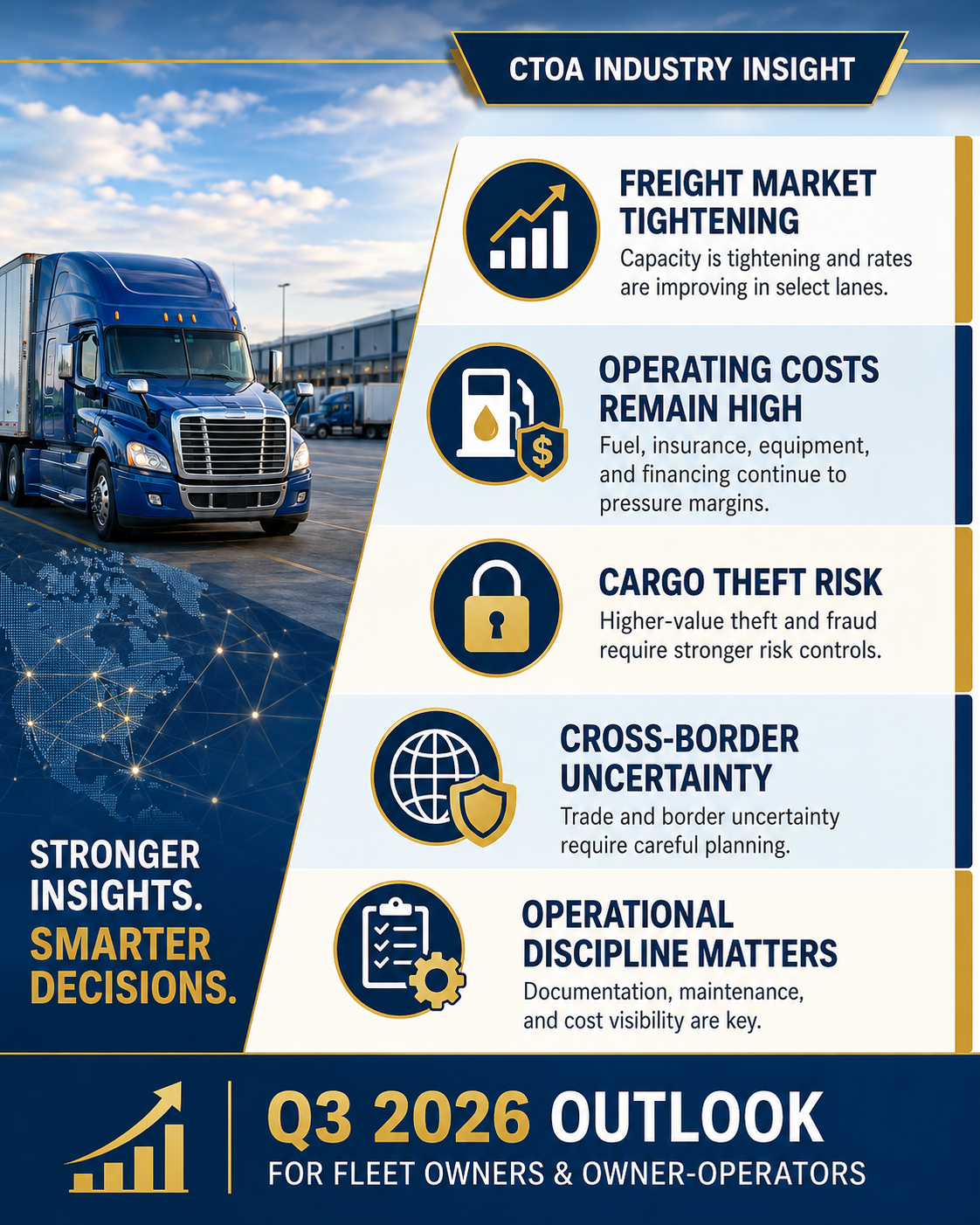
Industry Insight Series: Canada Truck Operators Association, Q3 2026 – July through September
Editor’s Note
The Canadian trucking industry sits at an inflection point. After a long period of compressed margins, volatile costs and intense competition, Q3 2026 arrives with signs of market tightening – but also with higher regulatory, insurance, fuel, equipment and cargo-security risk.
This report is written for the operators who are running the miles, not reading about them from a boardroom. The goal is to give CTOA members – fleet owners and owner-operators alike – a clear, practical view of where the market stands, what is coming in the next quarter, and what actions should be taken now.
Six Themes Defining Q3 2026
- Freight market tightening is real, but uneven. Spot-market pressure, route-guide failures and tender rejection signals suggest less available capacity than during the 2023-2025 downcycle. The improvement is strongest for disciplined carriers with good documentation, equipment readiness and customer relationships.
- This is a supply-side recovery, not a demand boom. Demand is not uniformly strong. Much of the rate pressure is being driven by carrier exits, operating-cost pressure, enforcement and reduced available capacity. Members should improve rates carefully, but continue to price every load by true cost.
- Compliance and documentation remain business fundamentals. The strongest operators will be those with organized driver, equipment, dispatch, maintenance, insurance, payroll, tax and customer records. A clean file is now part of operational discipline, not just paperwork.
- Cross-border planning faces CUSMA (USMCA) uncertainty. The six-year CUSMA (USMCA) joint review begins in 2026. A smooth extension would support stability, while prolonged negotiations would create recurring uncertainty for cross-border lanes and customer planning.
- Cargo theft and fraud are rising in value and sophistication. CargoNet reported estimated U.S./Canada cargo theft losses near US$725 million in 2025, with average theft value up 36% to US$273,990. Carriers should review insurance limits, identity-verification procedures and parking/security protocols.
- Operating discipline will decide who benefits. Diesel, insurance, equipment, financing, maintenance and payment delays continue to squeeze margins. The next quarter will reward operators who know their numbers, protect cash flow and maintain audit-ready records.
Freight Market Conditions: Tighter Than It Looks
North America’s freight market entered Q3 2026 with the surface appearance of stabilization, but with real structural tension underneath. For Canadian carriers – particularly small carriers and owner-operators who survived the 2023-2025 freight downcycle – some of that tension is beginning to work in their favour.
Spot Rates, Route-Guide Failures and Tender Rejections
Recent market updates describe a freight market that remains volatile and capacity-sensitive. FreightWaves reported that disruptions such as International Roadcheck quickly pushed tender rejections and spot rates higher, while C.H. Robinson reported that route-guide failures and tightening truckload capacity have become important signs of reduced slack in the market.
For CTOA members, the key point is that tender rejection data is primarily a U.S. truckload market signal, but it matters for Canadian carriers because North American freight lanes, cross-border capacity and shipper behaviour are connected. When available capacity tightens in the U.S., Canadian cross-border pricing, routing, broker behaviour and shipper expectations can change quickly.
If you operate in spot or cross-border freight, your negotiating position has improved from the weakest period of the downcycle. Use this window to review lane pricing, fuel recovery and customer payment terms. Do not accept higher headline rates without confirming the load is profitable after fuel, empty miles, waiting time, insurance, maintenance and payment delay.
Contract and Spot Rates: Recovery With Caution
Contract and spot rates have been improving from the 2024-2025 trough. C.H. Robinson’s April 2026 market update forecasted 2026 dry van truckload costs up 17% year over year and refrigerated truckload costs up 16% year over year. Other News networks also reported Canadian spot-rate strength in spring 2026, including higher spot rates and a supply-driven recovery dynamic.
Now is the time to review contract renewals and customer rates. The leverage exists, but it should be used strategically. Improve pricing on existing stable lanes before adding risky new lanes. A carrier can still lose money on a higher-paying load if the full cost is not calculated.
Intermodal and Modal Competition
When truckload capacity tightens, shippers often look to rail and intermodal alternatives. Reuters has reported that tighter truck capacity is giving U.S. railroads an opportunity to win back some freight. This is not necessarily a direct threat to every carrier, but it is a reminder that shippers will use all available options when truck pricing rises.
Members should maintain shipper relationships even when some freight temporarily shifts modes. Service reliability, communication and flexible capacity remain major advantages for trucking.
Compliance Is Now Part of Business Discipline
For small and mid-sized carriers, compliance should be treated as part of daily operations, not as a separate legal or political debate. The practical priority for Q3 is simple: keep records clean, current and easy to produce when needed.
Fleet owners should review driver files, equipment and maintenance records, insurance documents, permits, dispatch records, proof of delivery, payment records, contracts, payroll or contractor documentation where applicable, and customer communications. The goal is not to create fear, the goal is to reduce business risk, improve professionalism, and protect companies before small paperwork gaps become expensive operational problems.
Every carrier should be able to answer three questions quickly: Are our files current? Can we prove how each load was dispatched, delivered and invoiced? Can management see compliance, maintenance and payment issues before they become a crisis?
Medium-Term Policy Direction
Transport Canada and other public agencies continue to focus on safety data, zero-emission trucking planning, technology, equipment transition and future regulatory frameworks. These are not immediate Q3 pressures for most small carriers, but they show where the industry is heading: better records, better systems, cleaner operations and stronger accountability.
The CUSMA (USMCA) Countdown: What It Means for Your Loads
2026 Joint Review: Three Possible Worlds
The CUSMA (USMCA) is designed to last 16 years, expiring in 2036 unless the parties agree to extend it. Article 34.7 requires Canada, the United States and Mexico to conduct a formal review at the six-year mark. If the parties agree to extend, the agreement can continue with greater certainty. If they do not, annual reviews can create recurring uncertainty.
Cross-border operators should stress-test lane exposure before signing long-term commitments. Review which customers, routes, equipment and drivers depend heavily on U.S. trade flows. Build flexibility into pricing and contract language where possible.
Tariffs, Trade Friction and Lane Risk
Trade uncertainty can change freight flows quickly. Tariff pressure, customs complexity and customer hesitation can create strong rates on one lane and weak backhaul availability on another. Carriers should avoid looking only at the outbound rate; the full round trip must be profitable.
For Q3, domestic Canadian lanes may offer more planning stability than heavily exposed cross-border lanes. However, strong cross-border operators with disciplined paperwork, reliable equipment and customer relationships can still find opportunity.
The Margin Squeeze Continues
Equipment: The Tariff and Replacement-Cost Pressure
Tariff-related cost pressure may increase new commercial truck prices. S&P Global Mobility estimated tariff impacts could add roughly 9% to new truck prices and reduce demand by up to 17%. Some industry summaries have also cited potential Class 8 price increases around US$10,000 per unit, although this should be treated as an estimate rather than a fixed number.
For Canadian fleet owners considering equipment refreshes in 2026, the decision should be based on safety, reliability, revenue opportunity, financing cost and repair history. Delaying replacement may save capital in the short term, but keeping unreliable equipment can increase downtime, roadside risk and customer service failures.
Track repair cost by unit, not only total repair cost. A truck that keeps moving but constantly breaks down may be quietly destroying margin. Review preventive maintenance schedules, inspection records and recurring repairs before Q3 freight demand increases.
Fuel, Insurance and Payment Delay
Diesel, insurance and financing costs remain major margin risks. Fuel volatility can erase the profit on a lane if fuel surcharge recovery is weak or delayed. Insurance renewals may also become more challenging as cargo theft, claims costs and compliance expectations rise.
Payment delay remains a structural problem for small carriers. Waiting 30, 60 or 90 days for payment forces many operators into factoring or high-cost borrowing. Members should track average days-to-payment by customer and avoid building growth around customers who consistently delay cash flow.
Cargo Theft: The Fastest-Rising Risk
Cargo theft risk is rising in value and sophistication. CargoNet reported that estimated losses reached nearly US$725 million in 2025, up 60% from 2024, while average theft value rose 36% to US$273,990. Thefts are increasingly tied to identity fraud, fictitious pickups, phishing, cloned domains, double brokering and strategic cargo theft.
Food and beverages, electronics, automotive parts, metals and retail goods remain attractive targets. Members should not assume that traditional cargo coverage is enough for modern fraud-based theft schemes.
1. What is your current per-occurrence cargo limit, and does it reflect current average theft values?
2. Does your policy respond to strategic cargo theft, identity fraud, load interception and phantom carrier schemes?
3. Have you reviewed parking, seal, tracking, document and verification requirements in the past 12 months?
Q3 2026: Opportunities & Risks
Industry conditions can best be described as stabilization with structural turbulence. Freight pricing is improving in many areas, but the operating environment is more complex and more expensive than it was before the downcycle. The carriers positioned to gain ground in Q3 and Q4 are those who treat compliance, cash flow, safety, maintenance and cost visibility as core business functions.
Opportunities in Q3 2026
- Rate recovery is accessible. Carriers with reliable service and clean documentation are in a stronger negotiating position than during the freight recession.
- Compliance can become a competitive advantage. As enforcement increases, customers and brokers may prefer carriers with cleaner files, stronger documentation and predictable business practices.
- Domestic lanes may provide planning stability. Given CUSMA (USMCA) review uncertainty, some carriers may benefit from balancing cross-border exposure with domestic lanes.
- Technology and data are becoming essential. Small carriers should track cost per mile, lane profitability, customer payment history, maintenance cost by unit and empty miles.
Risks to Monitor
| Risk | Level | What to Watch |
|---|---|---|
| USMCA Review | High | Contentious negotiations or annual uncertainty would be most disruptive for cross-border operators. Review lane mix and customer concentration. |
| Demand Softness | Medium | Freight tightening is largely supply-driven. If consumer or manufacturing demand weakens, rate momentum could soften. |
| Fuel Shocks | Medium | Diesel remains sensitive to global events. Review fuel surcharge recovery and avoid underpriced lanes. |
| Cargo Theft and Fraud | High | Rising theft values and identity-based fraud require stronger verification, insurance review and documentation. |
| Classification and Compliance Audits | High | Review contractor arrangements, driver files, T4A reporting, payroll records and employment-law risk with qualified advisors. |
| EV and Decarbonization Policy | Monitor | Not a Q3 crisis for most small fleets, but policy direction suggests equipment transition planning will become more important. |
Before Q3, every member should review: real cost per mile, customer payment delays, profitable lanes, high-repair units, insurance limits, fuel surcharge recovery, compliance files, maintenance records, driver documentation and exposure to cross-border uncertainty.
Sources & Methodology
This industry insight report is prepared by the Canada Truck Operators Association for members and industry readers. It draws on public reporting and industry analysis available as of late June 2026. Market conditions can change quickly; members should consult qualified legal, financial, insurance and tax advisors before making material business decisions.