
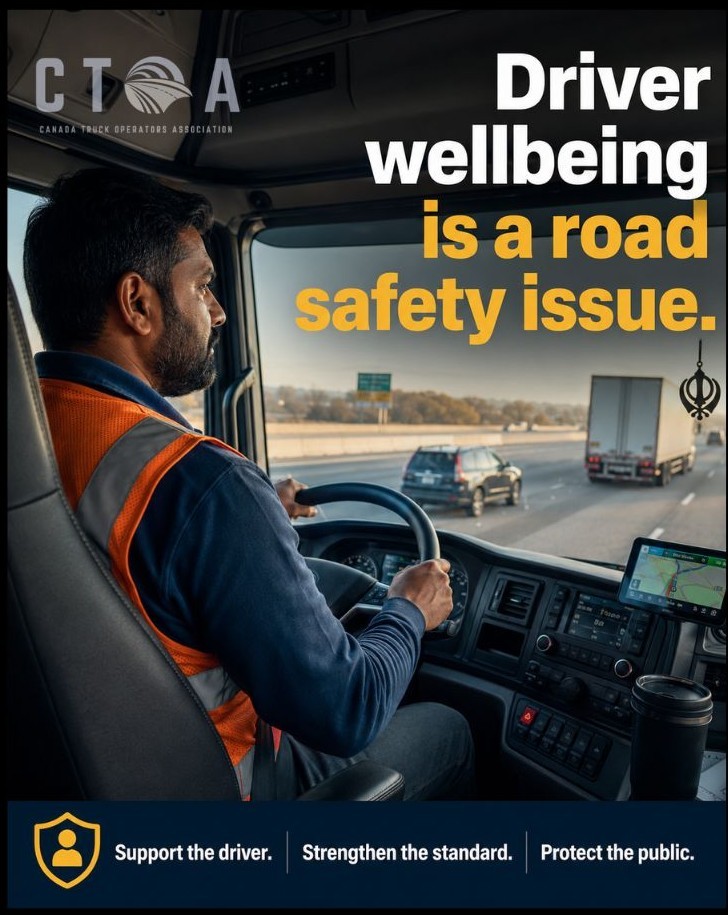
Canada’s trucking industry depends on professional drivers who spend long hours on the road, away from their families, under constant pressure to deliver safely, professionally, and on time.
Too often, public discussions about trucking focus only on enforcement, compliance, or isolated incidents. Those issues matter, but they are not the whole story. If Canada wants safer roads and a stronger supply chain, driver wellbeing must become part of the national transportation conversation.
Driver mental health is not separate from road safety. It is connected to fatigue, stress, focus, decision-making, workplace pressure, and the conditions drivers face every day.
Long-haul drivers often deal with extended time away from home, irregular schedules, traffic, weather, loading delays, inspection pressure, customer expectations, rising costs, and public judgment. For many drivers, the job affects not only their own health, but also their families and personal lives.
Despite these pressures, drivers continue to show up. They move food, medicine, construction materials, retail goods, manufacturing parts, and the everyday products Canadians rely on. During the COVID-19 pandemic, truck drivers were widely recognized as essential workers. That respect should not disappear when public debate becomes difficult.
CTOA believes driver wellbeing must be treated as a serious safety and workforce issue.
A driver who is exhausted, stressed, unsupported, or constantly under pressure is not being set up for success. A safer trucking industry requires stronger training standards, better fatigue awareness, mental health support, fair enforcement, practical compliance education, and respect for the people behind the wheel.
This does not mean lowering standards. It means strengthening safety by understanding the real conditions of the job.
CTOA supports strong road safety standards, fair and consistent enforcement, better training oversight, and accountability for unsafe or non-compliant operators. At the same time, policy discussions must include the voices of drivers, owner-operators, small carriers, fleet operators, safety professionals, training experts, and industry stakeholders who understand the realities of the road.
Canada’s trucking industry should not be reduced to one narrow narrative. Safety is connected to training, fatigue, equipment maintenance, mental health, insurance pressure, operating costs, cargo theft, enforcement consistency, and the day-to-day pressures placed on drivers and operators.
Supporting driver wellbeing is not only the right thing to do.
It is a road safety issue, It is a workforce issue and It is a supply chain issue.
CTOA will continue advocating for practical, evidence-based solutions that support safer roads, stronger operators, respected drivers, and a more resilient trucking industry.
Together, we keep Canada moving.