
Recent brokered freight offers, elevated operating costs and early National Trucking Industry Pulse feedback show why stronger headline freight volumes do not always mean healthy carrier margins
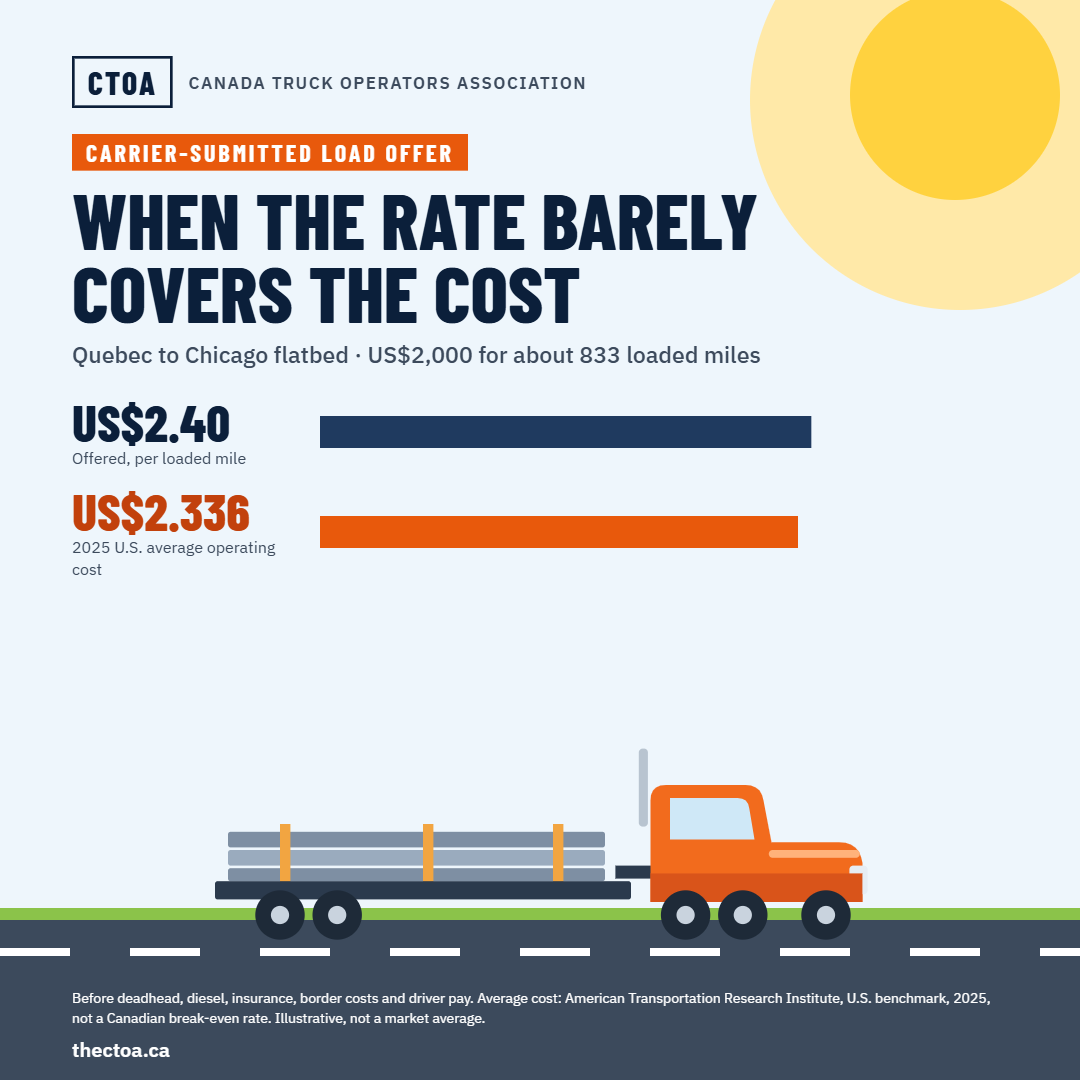
MISSISSAUGA, ON, Oct. 19, 2026 :- A recent Quebec-to-Chicago flatbed load offered to a Canadian carrier at US$2,000 works out to approximately US$2.40 per loaded mile, only slightly above the record US$2.336 average U.S. truck operating cost reported by the American Transportation Research Institute for 2025, before accounting for deadhead and the specific costs and risks associated with that cross-border move.
It is one of several recent broker load offers shared with the Canada Truck Operators Association (CTOA) by small and mid-sized fleet operators as the association gathers operating evidence on the pressures facing smaller trucking businesses across Canada.
Other recent carrier-submitted examples include:
- Boucherville, Que. to Mississauga/Toronto: C$1,100 for a flatbed/step-deck load involving two deliveries.
- GTA to Moncton, N.B.: C$2,500 all-in for a dry-van load involving two pickups and a two business day transit.
- Winnipeg to Montreal: C$2,400 for a next morning recovery load, with the carrier responsible for the associated operating and repositioning costs.
Company, broker and personal identifying information has been removed. CTOA stresses that these examples are illustrative operating evidence and are not presented as market averages.
Operating costs leave little room for error
The American Transportation Research Institute reported average U.S. truck operating costs of US$2.336 per mile in 2025, the highest level in the history of its benchmark. The figure includes major operating expenses such as fuel, maintenance, insurance, equipment and driver costs.
CTOA notes that the ATRI figure is a U.S. industry benchmark, not a Canadian break even rate. It nevertheless provides useful context for how narrow the margin can become when a Canadian cross-border offer is approximately US$2.40 per loaded mile before deadhead and trip-specific costs are considered.
In Canada, Statistics Canada reported producer diesel prices were 40.3% to 58.8% higher in July 2026 than a year earlier, depending on region. Among transportation and warehousing businesses expecting input costs to be an obstacle, 68.1% identified energy costs.
Canada’s trucking industry is also overwhelmingly made up of small businesses. Federal industry data show 99.5% of truck transportation employers have fewer than 100 employees, including 83.4% with fewer than five.
“Carriers do not operate on the posted load rate alone,” said Tej Dulat, Director of Government and Public Affairs at CTOA. “They have to account for empty miles, diesel, insurance, equipment payments, repairs, waiting time, driver compensation, border costs and whether there is viable freight coming back. When the economics no longer cover those costs, the carrier is effectively subsidizing the movement of someone else’s freight.”
Carriers raise concerns about re-brokering and freight transparency
Some carriers have also raised concerns with CTOA about re-brokering and broker layering, where freight may pass through multiple intermediaries before reaching the carrier ultimately performing the transportation service.
Carriers report that repeated re-brokering can reduce transparency and may reduce the amount ultimately available to the trucking company moving the freight.
CTOA is not suggesting that all brokers engage in these practices. Brokers are an essential part of Canada’s freight market, and many provide valuable customer access, credit support, freight coordination and market capacity.
The concern is with situations where freight is repeatedly re-brokered, identities become unclear, payment risk increases or multiple layers make it difficult for the carrier performing the work to understand the commercial structure behind the shipment.
National Trucking Industry Pulse Survey underway
CTOA is also collecting responses through its National Trucking Industry Pulse Survey – October 2026, seeking direct feedback from carriers, owner-operators and professional drivers across Canada.
Early feedback is reinforcing concerns around fuel costs, freight economics, trade uncertainty, business outlook and regulatory pressure.
Because participation is continuing, CTOA is treating the findings as preliminary and will publish updated results as the response base grows.
The anonymous survey takes approximately five minutes and is available at:
thectoa.ca/national-trucking-survey/
Wider indicators show an uneven freight environment
Loadlink’s September 2026 data showed Canadian spot-market postings remained above year-earlier levels, while outbound Canada–U.S. freight fell 12% from August, illustrating why national freight volumes do not necessarily reflect conditions on every lane or for every carrier.
Transportation and warehousing also recorded 136 Bankruptcy and Insolvency Act insolvencies in Q2 2026, up 36% from both the previous quarter and the same quarter a year earlier.
CTOA cautions that these figures do not indicate an industry-wide collapse. They do reinforce the need to examine what is happening at the operating level, particularly among smaller businesses with less ability to absorb prolonged cost and margin pressure.
CTOA proposes three practical steps
CTOA is asking governments to consider three practical measures:
- Launch a federal-provincial review of freight brokerage transparency. Bring carriers, legitimate brokers, shippers and other supply-chain partners together to examine re-brokering, double-brokering, identity verification, payment practices and freight transparency.
- Establish a small carrier operating cost and freight market dashboard. Track freight activity, fuel costs, business exits, insolvencies and other operating indicators by carrier size where reliable data are available.
- Make productivity and modernization programs practical for smaller fleets. Ensure small carriers and owner-operators can access fuel-efficiency, safety, digital technology and productivity investments without program structures that unintentionally exclude smaller businesses.
“Small and mid-sized carriers are not asking the government to protect them from normal competition,” Dulat said. “We are asking policymakers to look at the economics actually reaching the truck. Freight volumes can look healthy nationally while individual lanes become difficult to operate sustainably. Better transparency and better operating evidence will help carriers, brokers, shippers and governments make better decisions.”
CTOA will continue collecting survey responses, carrier-submitted load information and other operating evidence as part of its National Trucking Industry Pulse initiative.
CTOA recognizes that fleet owners, owner-operators, brokers and other supply-chain partners are all integral to Canada’s freight system. Strengthening transparency, fair business practices and cooperation across the industry will help build a safer, more resilient supply chain and a stronger Canada.
About the Canada Truck Operators Association
The Canada Truck Operators Association (CTOA) is a national organization representing and advocating for small and mid-sized carriers, owner-operators, independent operators and professional drivers across Canada.
Media and government inquiries:
Jas Kaur
Government & Public Affairs
Canada Truck Operators Association
info@thectoa.ca | +1 416-443-0042
thectoa.ca